
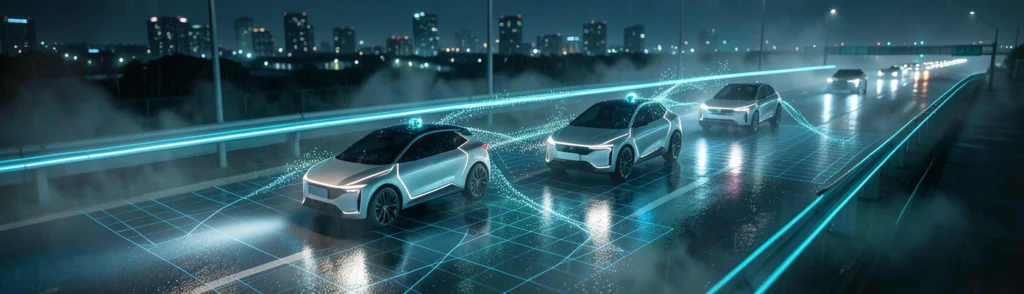

Intro: Why Cooperative Autonomous Driving Matters
Autonomous vehicles are becoming better at interpreting roads, predicting movement, and selecting safe actions. Yet even the most capable vehicle remains constrained by a fundamental physical reality: it can only directly observe what its sensors can reach.
A camera cannot see through a delivery truck. Radar may detect an object but provide limited detail about its identity or movement. Lidar can create a precise three-dimensional view, but buildings, vegetation, road curvature, and other vehicles still create blind spots. More computing power improves interpretation; it does not eliminate occlusion.
Cooperative autonomous driving addresses this limitation by allowing vehicles, roadside infrastructure, and other road users to share selected observations. A vehicle approaching an intersection might receive a warning that another car is hidden behind a building. A truck could transmit information about a stopped vehicle several hundred meters behind it. A roadside unit might identify a pedestrian entering a crosswalk before nearby vehicles have a clear line of sight.
The critical architectural principle is that shared information should improve local decision-making without replacing it. Each vehicle must remain capable of driving safely when communication is delayed, incomplete, corrupted, or unavailable.
Most autonomous-driving architectures can be summarized as:
Sensors → Perception → Prediction → Planning → Control
Cameras, radar, lidar, ultrasonic sensors, maps, and positioning systems provide inputs. Software transforms those inputs into detected objects, predicted trajectories, and driving decisions.
This model is powerful, but it is inherently first-person. The vehicle estimates the world from its own physical position. If a pedestrian is hidden behind a parked van, the vehicle cannot reliably infer the pedestrian’s presence simply by increasing neural-network size. The missing observation is a geometry problem, not merely a computation problem.
Consider three vehicles approaching a blocked intersection. The first vehicle may detect a cyclist crossing from the side. The second and third vehicles cannot see the cyclist because the first vehicle obscures the view. If the first vehicle shares a compact observation—including position, direction, timing, and uncertainty—the others gain an earlier warning.
This is similar to people navigating a crowded room. One person may see a blocked doorway, while another sees the approaching crowd. If they exchange observations, the group can move more safely than either individual could alone.
Cooperative autonomous driving is an ecosystem architecture in which vehicles and infrastructure exchange machine-readable observations, hazards, intent, and situational context.
It includes technologies such as:
- Vehicle-to-vehicle communication, or V2V
- Vehicle-to-infrastructure and vehicle-to-everything communication
- Roadside units and connected traffic signals
- Collective perception messages
- Shared maps and localized hazard reports
- Emergency-vehicle and vulnerable-road-user alerts
The goal is not to create one enormous centralized driving system. Instead, each participant maintains local autonomy while contributing and receiving evidence.
A vehicle might share:
- Its estimated position and velocity
- A detected object’s location and movement
- Road hazards or blocked lanes
- Braking or emergency status
- A predicted maneuver or intent
- Sensor class and confidence information
- Timestamp, source, and geographic validity
The shared representation need not expose raw camera feeds, lidar point clouds, or proprietary neural networks. That distinction is important for privacy, bandwidth, intellectual property, and cybersecurity.
Background: How Cooperative Autonomous Driving Works
Vehicle-to-vehicle communication creates a direct information layer between nearby road users. Depending on the deployment, messages may be transmitted through dedicated short-range communication, cellular-based systems, or future hybrid networks.
However, communication is not the same as cooperation. Sending a message is relatively easy. Agreeing on what the message means, how trustworthy it is, and how it should influence a driving decision is much harder.
A safe architecture treats V2V messages as inputs to local perception and planning rather than remote commands. The receiving vehicle remains responsible for deciding whether the message is relevant, credible, and actionable.
A vehicle first processes its own sensor data. It may detect a pedestrian, estimate the location of a pothole, or identify a vehicle braking sharply. The system then converts that local result into a standardized observation.
A useful shared observation could include:
- Object category
- Position and coordinate frame
- Velocity and direction
- Estimated dimensions
- Observation timestamp
- Confidence and uncertainty
- Sensor type
- Message origin and authentication status
- Expected expiration time
This is more useful than sending a simple statement such as “hazard ahead.” A receiving vehicle needs to know where the hazard is, when it was observed, how uncertain the estimate may be, and whether the observation remains relevant.
For example, a radar-based report of a rapidly approaching object should not be interpreted in the same way as a camera-based classification with uncertain depth. Interoperable systems therefore need common semantic and uncertainty models.
No vehicle should require uninterrupted connectivity to remain safe. Wireless signals can be blocked by tunnels, dense buildings, weather, hardware failures, spectrum congestion, or malicious interference. Some road users will never participate in the cooperative system.
Local autonomy is therefore the safety foundation. A vehicle must continue to:
- Detect nearby objects independently
- Maintain safe following distances
- Stop or slow when uncertainty becomes too high
- Navigate without current cooperative messages
- Reject contradictory or implausible data
Shared perception should reduce uncertainty, not create a new single point of failure. A useful analogy is aviation: pilots may receive air-traffic information, but they still need onboard instruments and direct situational awareness if communications fail.
Collective perception systems allow multiple observers to contribute partial views of the same environment. The combined result can be more informative than any individual sensor perspective.
Potential contributors include:
- Passenger vehicles and commercial trucks
- Buses and emergency vehicles
- Traffic lights and roadside cameras
- Smart intersections and road sensors
- Parking systems and work-zone equipment
- Connected bicycles or personal devices
- Mapping and maintenance fleets
Infrastructure can contribute observations that vehicles cannot easily generate. A traffic signal may know its current phase and timing. A roadside unit may monitor a crosswalk from an elevated position. A work-zone beacon may identify a temporary lane closure before it is visible around a curve.
The system does not require every participant to share everything. Data minimization is preferable. A vehicle may transmit only a hazard’s location and movement rather than its entire sensor stream.
Automakers will continue to use different sensors, operating systems, neural networks, maps, and decision-making strategies. Requiring identical internal software would be unrealistic and would reduce innovation.
The more practical approach is to standardize the external language of cooperation. Vehicles can preserve proprietary implementations while agreeing on concepts such as:
- Object identity and categories
- Coordinate systems
- Time synchronization
- Position and velocity
- Intent and trajectory
- Confidence and uncertainty
- Data provenance
- Expiration and revocation
A confidence score of 0.9 from one manufacturer cannot automatically be assumed to mean the same thing as 0.9 from another. Standards must define how confidence is calibrated, what sensor evidence supports it, and how uncertainty is represented.
Trend: From Connected Cars to Cooperative Perception
Connected-car systems initially focused on navigation, remote diagnostics, infotainment, traffic information, and emergency services. The next stage is more safety-critical: using connectivity to supplement direct perception.
Several forces are driving this transition:
- Growth in automated-driving functions
- More connected commercial fleets
- Deployment of cellular V2X technologies
- Smart-city and intelligent-intersection projects
- Demand for efficient traffic management
- Increasing interest in physical AI
As vehicles become mobile computing platforms, they can act as distributed sensors. A fleet moving through a city may collectively detect road damage, sudden braking, weather changes, congestion, and temporary hazards faster than centralized infrastructure alone.
Still, the trend should not be confused with a move toward total centralization. The most resilient architecture will likely combine local intelligence, peer-to-peer exchange, roadside infrastructure, and cloud-supported coordination.
The most direct benefit is extending the vehicle’s effective field of view. A car can receive a warning about an obstacle hidden behind a truck, a pedestrian entering a crosswalk, or a vehicle braking beyond a bend.
Earlier detection gives the local planner more time to respond. It may choose a smoother deceleration instead of emergency braking, or adjust lane position before the hazard becomes visible.
Intersections are difficult because vehicles, cyclists, pedestrians, and turning movements interact across multiple lines of sight. Cooperative observations can expose traffic approaching from behind buildings or stopped vehicles.
At highway merges, vehicles can share position and intended movement. This could help automated systems identify usable gaps earlier and negotiate merges with less abrupt acceleration or braking.
Emergency vehicles could broadcast authenticated status and approximate trajectories. Nearby vehicles might receive earlier warnings and adjust lanes before an ambulance or fire engine becomes visible.
Road infrastructure could also coordinate signal timing and warn traffic behind obstructions. The objective would be to improve predictability without granting an emergency vehicle unlimited authority over other road users.
Autonomous vehicles often behave conservatively when they lack information. That caution is safer than guessing, but widespread uncertainty can produce unnecessary braking, large gaps, and inefficient merges.
Shared observations can reduce uncertainty. If a vehicle knows that a lane is clear beyond a visual obstruction or that a merging vehicle has already slowed, it may make a smoother decision.
The result could be lower shockwave congestion, improved fuel or energy efficiency, and more consistent travel times.
A single sensor can fail. A single message can be wrong. Multiple independent observations provide redundancy.
If two vehicles, a roadside unit, and a traffic signal report compatible information, the receiving vehicle can assign greater confidence to the combined evidence. If one source conflicts with the others, the local system can discount it rather than accepting it blindly.
Cooperative autonomy distributes observation while preserving local decision-making. Each vehicle evaluates incoming information according to its own sensor state, software policies, safety constraints, and mission.
This architecture resembles a group of doctors sharing test results while each remains responsible for a patient’s diagnosis. Shared evidence improves judgment, but no single report automatically dictates the final action.
A centralized model might attempt to collect all vehicle data in a cloud system and issue driving instructions. This could simplify coordination in controlled environments, but it creates major challenges:
- Network latency
- Connectivity gaps
- Massive data volumes
- Central points of failure
- Large cybersecurity targets
- Difficult liability questions
- Potential surveillance concerns
The cloud is well suited to credentials, maps, software updates, analytics, standards, and revocation services. It is poorly suited to making every immediate braking or steering decision.
Insight: How Cooperative Autonomous Driving Preserves Trust
Connected car cybersecurity must be designed into cooperative autonomy from the beginning. A false hazard report could cause unnecessary braking. A forged emergency-vehicle message could manipulate traffic. A compromised fleet could inject thousands of coordinated observations.
Messages should be authenticated so recipients can determine whether they originated from an authorized participant. They should also carry provenance information describing the source, generation time, sensor class, and geographic scope.
Credentials must be revocable. If a vehicle is compromised, its ability to contribute should be suspended without disabling the broader network.
Privacy-preserving credential systems can allow a message to be trusted without revealing a driver’s long-term identity. Short-lived or rotating identifiers can reduce unnecessary tracking.
Authentication proves that a message came from a recognized source. It does not prove that the content is correct.
Vehicles should evaluate:
- Age and expiration time
- Physical plausibility
- Geographic relevance
- Agreement with local sensors
- Agreement with independent contributors
- Sudden changes in reported behavior
- Sensor limitations
- Historical reliability
A message reporting a stationary object at a location five minutes earlier may be irrelevant if traffic has moved. A claimed velocity may be impossible given the reported position history. Cooperative systems need automated skepticism.
Privacy-preserving mobility requires more than removing names from databases. Location patterns can identify individuals, routines, workplaces, homes, and social relationships.
The safest design is to share only the information needed for the immediate safety function.
Vehicles already detect pedestrians, cyclists, and other road users who have not opted into connectivity. Their presence can be represented anonymously as an object with position, movement, and uncertainty.
The system does not need to identify the person. It needs to know that a vulnerable road user is present and may intersect with a vehicle’s path.
This approach supports safety benefits without requiring universal registration or continuous personal tracking.
Some road users may choose to actively participate through smartphones, wearables, bicycle computers, or dedicated safety devices. Active participation can improve visibility in difficult conditions, such as when a cyclist is behind a large vehicle or a pedestrian is approaching a blind crossing.
Participation should be voluntary, transparent, and revocable. Users should understand:
- What data is shared
- With whom it is shared
- How long it is retained
- Whether it is used only for immediate safety
- How identifiers are protected
- What happens when the device is offline
A receiving vehicle should combine cooperative messages with local perception rather than treating them as commands.
A practical evidence model considers:
- Timing: Is the observation current?
- Uncertainty: How precise is the location or classification?
- Corroboration: Do independent sources agree?
- Sensor class: Was the object detected by radar, lidar, camera, or infrastructure?
- Provenance: Is the source authenticated and authorized?
- Physical consistency: Does the report fit known road geometry and movement?
This is similar to weather forecasting. A forecast is not the weather itself; it is an estimate based on measurements, models, and uncertainty. Cooperative driving messages should be interpreted in the same way.
When shared information disappears, the vehicle should degrade gracefully. It may increase following distance, reduce speed, avoid complex maneuvers, or rely entirely on onboard sensors.
Graceful degradation is more important than maximizing performance under ideal connectivity. A system that performs exceptionally when connected but becomes unsafe during an outage is not robust autonomy.
Forecast: What Cooperative Autonomous Driving Needs to Scale
The industry needs common data structures for representing observations across manufacturers and jurisdictions. These formats should support objects, trajectories, road hazards, infrastructure states, and vehicle intent.
Standards should define not only fields but also coordinate systems, timestamps, update rates, error bounds, and expiration behavior.
Uncertainty cannot be an optional label added after the fact. A vehicle needs to know whether a position estimate is accurate within centimeters or several meters, whether an object classification is certain, and whether a trajectory is a prediction or a direct observation.
Common models would make confidence values more meaningful across systems. They could also support certification and automated policy decisions.
If a vehicle acts on a false cooperative message, responsibility may involve the message producer, communication provider, software developer, vehicle manufacturer, fleet operator, or infrastructure owner.
Governance frameworks will need to define:
- Who certifies message-generation systems
- How safety updates are approved
- How incidents are reconstructed
- Which party controls revocation
- How liability is allocated
- What audit records must be retained
The legal system will need to distinguish between a faulty observation, an unreasonable interpretation, and a local control failure.
Cooperative autonomy becomes more useful as participation grows. Early adopters may need incentives to contribute data before the network reaches critical scale.
Potential incentives include:
- Lower insurance risk
- Fleet efficiency gains
- Priority services
- Reduced congestion charges
- Better emergency coordination
- Infrastructure funding
- Shared safety certification
These incentives must not pressure people into surrendering unnecessary personal data. Participation should create value without becoming a condition for basic mobility.
Cloud systems can provide essential ecosystem services, including:
- Credential issuance
- Certificate revocation
- Map updates
- Software distribution
- Standards registries
- Threat intelligence
- Fleet-level diagnostics
- Incident analysis
Cloud infrastructure can also help coordinate trust across manufacturers and regions without becoming the real-time authority for every vehicle.
Immediate driving decisions depend on milliseconds, local context, and sensor fusion. Sending every decision through a remote service introduces latency and connectivity risk.
The likely future architecture is hybrid: cloud-supported trust and coordination, edge-based perception exchange, and local control. The cloud may help a vehicle understand which sources to trust, but the vehicle should decide whether to brake.
Call to Action: Prepare for Cooperative Autonomous Driving
Automakers should design external perception interfaces that support standardized observations without exposing proprietary models or raw sensor data.
They should test systems under:
- Conflicting messages
- Delayed communication
- Missing participants
- Spoofed identities
- Sensor failures
- Dense urban occlusion
- Poor weather
- Partial infrastructure outages
Interoperability should be treated as a safety requirement, not merely a commercial feature.
Roadside units, traffic signals, work-zone systems, and intersection sensors can provide valuable viewpoints. Infrastructure operators should prioritize authenticated, time-synchronized, privacy-aware observations.
They should also plan for maintenance, calibration, software updates, physical tampering, and clear ownership of generated data.
Mobility platforms should minimize data collection, use rotating identifiers, encrypt sensitive information, and provide understandable participation controls.
Security teams must monitor both individual attacks and coordinated manipulation. A system can be vulnerable even when every individual message appears legitimate if compromised sources collaborate.
Drivers and other road users should understand how connected features affect safety, privacy, and responsibility. Participation settings should be easy to find and change.
People should also recognize that opting out of active communication does not necessarily make them invisible: vehicles may still detect them through ordinary sensors. The distinction is between passive anonymous perception and active data contribution.
Conclusion: Cooperative Perception Without Losing Local Control
Cooperative autonomous driving should not replace strong onboard sensing, prediction, planning, and control. Local autonomy remains essential when connectivity fails, data conflicts, or other road users do not participate.
The safest architecture is one that can operate independently but performs better with credible shared evidence.
Vehicle-to-vehicle communication and collective perception systems can extend the informational horizon of autonomous vehicles. They can reveal hidden hazards, improve intersection awareness, support emergency coordination, and make traffic flow more predictable.
The future challenge is not simply connecting more cars. It is creating a trustworthy language for exchanging observations while preserving privacy, interoperability, and local authority.
If manufacturers, infrastructure operators, policymakers, and mobility platforms establish strong standards and governance, cooperative autonomy could make roads behave less like isolated machines and more like a resilient sensing ecosystem. The vehicle will still make its own decisions—but it will make them with a clearer view of the world.