
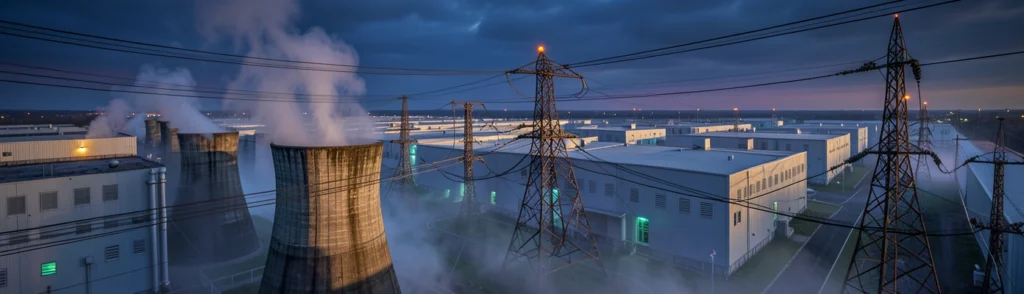

Intro: Why AI Data Center Infrastructure Is the New Bottleneck
Artificial intelligence is often described as a software revolution, but its next phase will be determined by physical infrastructure. Training and deploying larger models requires enormous quantities of electricity, advanced cooling systems, high-bandwidth memory, faster storage, and increasingly sophisticated networks. These resources are not expanding at the same pace as demand.
That makes AI data center infrastructure the new bottleneck. The limiting factor is no longer simply whether companies can design a more capable model. It is whether they can secure grid capacity, obtain memory components, cool dense computing systems, and operate facilities without creating unacceptable pressure on local water supplies.
The infrastructure challenge is easy to underestimate because AI services appear intangible. A user sends a prompt and receives an answer in seconds. Behind that interaction, however, servers move data across high-speed networks, GPUs perform intensive calculations, storage systems retrieve model weights, and cooling equipment removes the resulting heat. The prompt is digital; the supporting system is industrial.
The AI boom is increasing demand across several connected layers:
- Electricity generation and transmission
- Data center power distribution
- GPUs, CPUs, and high-bandwidth memory
- Networking equipment and optical links
- Cooling systems and water supplies
- Storage capacity and data movement
- Construction, land, and specialized labor
These constraints reinforce one another. A facility may have enough land but lack a grid connection. It may have sufficient electricity but inadequate water access. It may have servers but not enough high-bandwidth memory to keep GPUs fully utilized.
A useful analogy is a highway system. Adding more cars does not solve congestion if roads, bridges, and fuel stations remain limited. In AI infrastructure, GPUs are the cars, electricity is the fuel, networks are the roads, and cooling is the system that prevents the entire transport network from overheating.
This guide examines three major bottlenecks: AI data center power demand, data center water consumption, and the AI memory shortage. It also considers the less visible constraints affecting storage, networking, and sustainability.
The analysis separates established infrastructure realities from more speculative projections. For example, water use per AI prompt is not a universal constant. It changes according to model size, facility design, climate, season, cooling technology, and whether the calculation includes only on-site consumption or broader indirect water use.
Likewise, forecasts that memory shortages could persist through 2030 reflect genuine manufacturing and demand pressures, but they also come from companies that benefit financially from strong future demand. The right conclusion is not that every prediction will be accurate. It is that AI infrastructure planning now requires longer time horizons and better resource reporting.
Background: What Is AI Data Center Infrastructure?
AI data center infrastructure is the combined physical and operational foundation used to train, fine-tune, and run artificial intelligence systems. It includes compute hardware, power delivery, networking, storage, cooling, memory, buildings, and the software that coordinates these components.
Traditional data centers were largely designed around enterprise applications, web services, databases, and virtualization. AI facilities introduce a different operating profile: higher rack power, more parallel processing, faster data movement, and greater sensitivity to memory and network performance.
Compute, networking, storage, and cooling
Compute systems include GPUs, CPUs, accelerators, and the servers that connect them. GPUs are particularly important because they can execute many mathematical operations in parallel, making them effective for neural-network training and inference.
Networking connects these processors. During model training, thousands of accelerators may need to exchange data rapidly. Delays between machines can reduce utilization, meaning expensive GPUs spend more time waiting.
Storage supplies training datasets, checkpoints, model weights, logs, and inference data. Conventional storage often relies heavily on host CPUs to locate files, translate addresses, and manage metadata. Emerging file-semantic storage attempts to move some of that work into SSD controllers, allowing GPUs, DPUs, and network cards to access data with less CPU involvement.
Cooling removes heat generated by electrical equipment. Air cooling remains common, but higher-density AI racks are increasing interest in direct-to-chip liquid cooling, immersion cooling, and closed-loop systems.
Power delivery and memory capacity
Power infrastructure includes utility connections, substations, transformers, switchgear, backup systems, and internal distribution equipment. A data center may receive electricity from the grid, but that does not mean every planned rack can be installed immediately. Transformers and transmission upgrades can take years.
Memory is equally important. High-bandwidth memory, or HBM, sits close to advanced AI accelerators and supplies data at very high rates. Conventional DRAM supports system operations, while solid-state storage holds larger datasets. If memory cannot deliver data quickly enough, compute capacity is underused.
Traditional applications often produce relatively variable and distributed workloads. AI training, by contrast, can run thousands of accelerators at high utilization for extended periods. Inference workloads may also be unpredictable, especially when a popular model experiences sudden demand.
AI racks can consume several times more power than conventional enterprise racks. They also generate more heat in a smaller physical footprint. This is why simply placing AI servers into an existing facility can create power and cooling problems.
The difference resembles replacing a city’s passenger cars with freight trains. The same route may technically be available, but the bridges, stations, power systems, and maintenance schedules may not be designed for the new load.
Trend: 5 Pressures Reshaping AI Data Center Infrastructure
Why GPUs increase electricity requirements
AI accelerators require substantial electricity, particularly during large-scale training. The total demand includes the accelerator itself, host CPUs, memory, networking, storage, cooling, and power-conversion losses.
AI data center power demand is therefore more than the nameplate rating of a GPU. A facility’s power usage effectiveness, or PUE, determines how much additional electricity is required beyond computing equipment.
Higher-density systems create another challenge: even if total regional electricity supply is adequate, local distribution equipment may not support the concentration of demand. A data center cluster can behave like a new industrial district rather than an ordinary office building.
Grid capacity and connection delays
Grid interconnection is increasingly becoming a schedule risk. Utilities may need to build substations, reinforce transmission lines, or procure transformers before a facility can operate at its planned capacity. In some regions, these upgrades take longer than the construction of the data center itself.
On-site generation, battery storage, and long-term renewable energy contracts can reduce exposure, but they do not eliminate the need for reliable grid infrastructure. Solar and wind resources also require balancing systems because AI workloads generally operate continuously.
Cooling technology, climate, and facility location
Data center water consumption varies considerably. Facilities using evaporative cooling may consume more water in hot or dry climates, while air-cooled or closed-loop systems may reduce direct consumption but require more electricity or higher capital costs.
There is no single water figure for an AI prompt. Estimates depend on the model, workload, facility, season, and accounting boundary. A calculation based on a national average cannot describe every data center.
Water withdrawal vs. water consumption
Water withdrawal refers to water taken from a source. Water consumption generally refers to water not returned to the same source, often because it evaporates. These measurements have different environmental implications.
This distinction matters in public debate. A facility that withdraws water for heat exchange and returns most of it is not equivalent to one that evaporates water from a stressed aquifer. National averages can also hide local impacts. Data centers may represent a relatively small share of total water use across a country while creating a significant demand for a particular municipality.
Closed-loop cooling, reclaimed water, and immersion systems can reduce pressure. Hyperscale operators have also announced water-positive ambitions, but those commitments require transparent definitions and independently verifiable measurements.
High-bandwidth memory and DRAM demand
The AI memory shortage is closely linked to accelerator demand. Modern GPUs need high-bandwidth memory to move data quickly between processing cores. AI servers also require large quantities of system DRAM and fast storage.
When memory supply is constrained, companies may receive accelerators without enough supporting components to deploy them at scale. Memory can therefore become the missing part of an otherwise complete server.
Why new memory capacity takes years to build
Memory manufacturing depends on advanced fabrication equipment, packaging capacity, clean-room construction, engineering expertise, and quality-control processes. New facilities cannot be brought online instantly, and advanced packaging has become an important constraint for AI accelerators.
Memory manufacturers have warned that supply pressure could persist through 2030. Those forecasts should be treated carefully because suppliers have commercial incentives to emphasize long-term demand. Nevertheless, the underlying constraints are credible.
Demand is also broadening. Enterprise AI, autonomous vehicles, robotics, and other forms of physical AI may require significant memory and storage per device. A humanoid robot, for example, could need hundreds of gigabytes of RAM and multiple terabytes of storage, according to industry projections.
CPU bottlenecks in conventional AI storage
AI workloads can overwhelm storage systems not because flash memory is too slow, but because CPUs spend too much time managing file operations, metadata, address translation, and network requests.
This is similar to a warehouse where forklifts are fast but a single clerk must approve every item movement. Increasing forklift speed does little if the clerk remains the bottleneck.
File-semantic storage and NVMe over Fabrics
File-semantic SSD designs attempt to process file lookup and access operations inside the storage device. NVMe over Fabrics can then allow remote machines, GPUs, DPUs, and network cards to access storage across a high-speed fabric.
These systems could reduce CPU overhead and improve efficiency, but many remain early-stage technologies. Vendor claims about power savings, throughput, or cost reductions need independent testing. Industry-standard command sets, software compatibility, security, and operational reliability will determine whether such designs achieve broad adoption.
Closed-loop cooling and reclaimed water
Sustainable AI infrastructure is moving from a branding advantage toward an operational necessity. Closed-loop cooling recirculates coolant, reducing ongoing water consumption. Reclaimed wastewater can substitute for potable supplies where regulations and treatment systems allow.
Immersion cooling may support high-density systems, although it introduces equipment, fluid-management, maintenance, and supply-chain considerations.
Efficiency targets and water-positive commitments
Operators are increasingly publishing targets for energy efficiency, renewable power, carbon reduction, and water replenishment. These commitments are useful, but comparison remains difficult when companies use different boundaries.
A credible sustainability report should distinguish between direct facility water use, indirect water associated with electricity generation, withdrawals, consumption, discharge quality, and replenishment projects.
Insight: How AI Data Center Infrastructure Constraints Compare
There is no universal ranking. Power is likely to be the dominant constraint for large training clusters, memory may limit server deployment, and water may determine whether a facility can operate in a specific region.
Comparing infrastructure impact by location and workload
A dry region with limited water supplies may treat cooling water as the primary constraint. A location with abundant water but weak transmission capacity may face a power bottleneck. A cloud provider expanding accelerator capacity may be constrained by HBM and advanced packaging rather than land or electricity.
Why national averages can hide local constraints
National statistics can make a sector appear manageable while individual communities experience concentrated impacts. This applies to both electricity and water. Infrastructure planning should therefore evaluate facility-level demand, peak use, seasonal variation, and local resource conditions.
Evaporative cooling and its water trade-offs
Evaporative cooling can be energy-efficient because evaporation removes heat effectively. Its trade-off is direct water consumption, especially during hot weather.
Closed-loop and immersion cooling
Closed-loop and immersion systems can reduce water use and support higher rack densities. However, they may require greater upfront investment, specialized maintenance, new safety procedures, and different hardware designs.
The best system depends on climate, energy prices, water availability, workload density, and regulatory requirements.
Manufacturing complexity and long construction timelines
Memory production cannot expand as quickly as software demand. Fabrication plants, packaging lines, and supply chains require substantial capital and long planning cycles.
Demand from enterprise AI, robotics, and autonomous vehicles
AI demand may spread beyond cloud data centers. Enterprise inference, industrial automation, autonomous driving, and robotics could create additional memory requirements. This broadening demand makes a short-lived shortage less certain, even if some training demand slows.
Forecast: What Comes Next for AI Data Center Infrastructure?
Grid modernization and on-site energy strategies
Utilities and developers will likely invest in new substations, transmission capacity, batteries, flexible generation, and improved demand forecasting. Some facilities may use on-site generation or microgrids to reduce connection delays.
These approaches can improve reliability, but they may also raise questions about emissions, fuel supply, noise, and local air quality.
Regional effects on data center development
Data center construction will increasingly follow power availability rather than simply land prices or tax incentives. Regions with surplus generation, strong transmission networks, cooler climates, or abundant low-carbon electricity may gain an advantage.
Standardized facility-level water reporting
Future regulation is likely to require clearer reporting of withdrawals, consumption, discharge, seasonal peaks, and water sources. Standardization would make it easier for communities to compare projects.
More efficient cooling and alternative water sources
Reclaimed water, dry cooling, heat reuse, and closed-loop designs should grow. However, lower water use may involve higher electricity demand, so sustainability assessments must consider both resources together.
High-bandwidth memory and advanced packaging
HBM capacity and advanced packaging will remain strategic priorities. Chipmakers and memory suppliers are likely to invest in new facilities, but supply will respond gradually rather than immediately.
Rising demand from physical AI
Robotics and autonomous systems could become a major memory-demand source later in the decade. Unlike cloud inference, physical AI places memory and compute closer to machines operating in real environments.
Higher compute density
AI racks will continue to demand more power and advanced liquid cooling.
More specialized storage
File-semantic SSDs, computational storage, and faster flash may reduce CPU involvement.
Greater use of DPUs and network offload
DPUs can handle networking, security, storage, and virtualization tasks that would otherwise consume host CPU resources.
Tighter resource disclosure
Investors, regulators, and communities will demand clearer energy and water data.
Growth of sustainable AI infrastructure
Efficiency, water resilience, and low-carbon power will become central design requirements rather than optional features.
Call to Action: Prepare for AI Infrastructure Constraints
Identify the most exposed infrastructure resources
Organizations should map their dependence on grid capacity, cooling water, HBM, DRAM, storage, and network bandwidth. A project that appears compute-ready may still be constrained by one of these supporting systems.
Measure workload efficiency and resource use
Teams should track energy per training run, inference efficiency, storage traffic, memory utilization, cooling demand, and peak resource use. Measurement turns general sustainability claims into operational decisions.
Improve cooling and water management
Evaluate direct-to-chip cooling, closed-loop systems, reclaimed water, heat reuse, and facility siting together. No single technology is universally best.
Plan memory and storage capacity earlier
Memory procurement should be part of accelerator planning rather than an afterthought. Storage architecture should also be designed around data movement, metadata, and CPU overhead.
Companies and policymakers should support facility-level reporting that distinguishes withdrawals from consumption and includes energy sources, peak demand, cooling technology, and regional conditions. Better disclosure improves public trust and helps prevent both exaggerated claims and understated risks.
Conclusion: Building AI Data Center Infrastructure That Can Scale
AI growth is increasingly shaped by three physical constraints: power, water, and memory. Power determines whether systems can run at scale. Water influences where facilities can be built and how they are cooled. Memory determines whether accelerators and intelligent devices can operate efficiently.
Storage and networking add a fourth layer of pressure by determining how quickly data reaches compute resources.
The next phase of AI will not be won by model capability alone. It will depend on whether infrastructure can expand responsibly and reliably.
Efficiency improvements can reduce pressure, but they do not guarantee lower total resource use if demand grows faster than efficiency gains. Transparency is therefore essential. Public claims about AI water use, energy demand, and sustainability must be tied to consistent measurements and clear boundaries.
The most resilient approach combines long-term grid planning, diversified memory supply, efficient storage, advanced cooling, alternative water sources, and facility-level reporting. AI data center infrastructure is not merely a support system for the technology. It is becoming one of the primary factors that determines how quickly, where, and under what conditions artificial intelligence can scale.