
How Job Seekers Are Using Interview Automation to Beat ATS Filters (and What HR Won’t Say)
Job seekers are increasingly turning to interview automation to improve matching, reduce response latency, and—most controversially—reduce the odds their answers get auto-flagged by ATS-adjacent systems. The technical twist is that these “automation” workflows often aren’t just about generating text. They’re about controlling what the AI agent can see and do, especially when tools are involved (calendars, email drafts, form fillers, document generators, and sometimes CRM-like job application portals).
For HR teams, the uncomfortable truth is that token spend and evaluation failures are both tied to the same root cause: uncontrolled tool exposure inside AI agents. This is where the Main Keyword: MCP tool scoping for AI agents token cost becomes relevant. Scoping—implemented via Model Context Protocol (MCP)-aware tool lists—can dramatically reduce “prompt overhead” so agents generate faster and cheaper responses while also limiting unsafe actions. And for job seekers, that governance gap is exactly what creates an advantage.
Below is what’s happening, why ATS is hard to beat without controlled automation, and what HR may not be saying out loud about the security and compliance trade-offs.
MCP tool scoping for AI agents token cost: the interview advantage
Most interview automation stories you’ll hear focus on “better answers” or “faster rehearsals.” But under the hood, job seekers are often optimizing agent behavior like engineers optimize infrastructure. A key lever: MCP tool scoping for AI agents token cost.
When an AI agent is connected to tools through Model Context Protocol, the model typically receives a representation of the tools it could call. If that tool inventory is large and poorly scoped, the model must ingest a lot of metadata every turn. That metadata is effectively prompt overhead reduction-critical because it increases tokens consumed during inference—whether or not the agent actually uses the tools.
Think of it like packing for a trip: if you bring every kitchen utensil “just in case,” you waste space and time even when you only use a spoon. In LLM terms, that extra utensil list becomes tool tax—tokens spent on describing options, not on producing the final response.
Model Context Protocol (MCP) is a framework for connecting LLM agents to external capabilities—think “tools”—in a structured way. In hiring workflows, those tools may include:
– Drafting and tailoring interview responses for specific competencies
– Generating role-specific STAR stories
– Formatting documents (cover letters, summaries, reports)
– Preparing data for interview systems (e.g., uploading files, populating forms)
– Scheduling and communication actions (email drafts, calendar prompts)
The point isn’t that MCP makes interviews easier. It makes automation composable: agents can be assembled from modular capabilities rather than bespoke scripts.
However, MCP can also expose a broader tool universe than needed. If the agent sees too many tools, two things happen:
1. Token cost rises (more tool schema/context is included).
2. Risk increases (agents can attempt actions outside a safe scope).
For job seekers, the advantage comes when they can run agents with tighter tool lists than the employer’s systems—or when they can avoid the employer’s guardrails by using consumer-grade setups that don’t enforce enterprise-grade identity rules.
In an MCP integration, tool lists describe what the agent can access: names, descriptions, parameters, and invocation details. Even if the agent never calls certain tools, the model may still need to process their definitions.
This is why prompt overhead reduction matters. Scoping the tool list can reduce the number of tokens burned each turn by shrinking the tool inventory presented to the model.
A simple analogy: imagine you’re studying for an interview and you get a page listing 200 job titles “for reference,” but you only need 5. Reading the rest doesn’t help—you just waste attention. In practice, tool schema verbosity works the same way.
In practical hiring automation, MCP scoping can translate to measurable outcomes:
– shorter generation times (less context to digest)
– fewer retries (less confusion from irrelevant tool options)
– lower overall token usage for long practice sessions
– more consistent formatting outputs for interview artifacts
Job seekers who understand this tend to design their agent flows like performance engineers: they minimize unnecessary context, and they scope tools to only what the workflow requires.
Why ATS is hard to beat without controlled automation
ATS is not just “a resume parser.” It’s a pipeline: parsing, normalization, ranking, keyword extraction, and downstream workflow triggers. Even when an employer isn’t explicitly using ATS filters for interview content, many organizations still run semi-automated screening and evidence collection around hiring decisions.
That creates a tension: job seekers want to automate preparation, but ATS mismatch failures can still occur when the generated material doesn’t align with expected signals.
The challenge is that automation can fail in ways that are invisible to the user until the damage is done.
Here are common failure modes that cause ATS mismatches when automation is not governed:
1. Semantic drift
The agent produces a compelling response that doesn’t map to the role’s competency taxonomy. ATS-like systems often expect evidence aligned to consistent phrasing patterns and structured keywords.
2. Template leakage
Interview automation sometimes uses overly generic templates. The response sounds “AI-generated” because it repeats predictable structure. Some ATS-adjacent scoring systems penalize unnatural repetition or inconsistent formatting.
3. Tool-driven formatting errors
When agents have broad tool access, they may produce outputs in the wrong format (wrong sections, missing headers, mismatched file types, or incorrect form fields). That breaks the pipeline and can look like low-quality work.
4. Unauthorized or unverifiable actions
If the automation attempts steps that are not meant for the job seeker’s identity context (e.g., “uploading to an internal portal” vs “preparing a document for upload”), it can fail silently or cause downstream flags.
This is where controlled automation becomes decisive. Without scoped tools, an agent can make “reasonable” but contextually incorrect actions—like a candidate confidently uploading the wrong file because it had permission to upload something but no guardrail for the specific slot.
A second analogy: it’s like driving with the GPS set to “avoid tolls,” but the car’s app includes every route and every toggle. If you can’t lock the options, you can’t guarantee the route you’ll actually take.
Controlled automation isn’t only about security. It’s about deterministic behavior under constraints—especially those imposed by ATS-driven processes.
Background: identity governance and least-privilege tool visibility
The most important design shift is moving from “agents that can do everything” to agents that can only do what they’re entitled to do. That’s the realm of identity governance and least-privilege tool visibility.
When tool visibility is controlled, token cost also becomes controllable. This is because the tool list—what the model sees—becomes a reflection of identity entitlements, not a reflection of “everything the developer integrated.”
Identity governance is the practice of defining and enforcing what an entity (user, service account, agent identity) is allowed to access and perform. For AI agents, this translates to:
– which tools the agent can see
– which tool parameters can be used
– what actions are permitted at runtime
– how approvals and checks happen before execution
When identity governance is implemented properly, it doubles as cost control. It constrains the tool inventory presented to the model, which reduces MCP tool scoping for AI agents token cost.
A key operational distinction: cost control is often best done at the identity and scope layer, not only at billing meters. Otherwise, you still pay for the tokens consumed while the model considers too many options.
Some organizations rely on gateway spending controls: “cap tokens,” “throttle usage,” or “meter requests.” But those approaches react after context has already been consumed.
Identity-scoped scoping is different: it changes what the model sees before the inference step. If unauthorized tools never enter the prompt, the model never burns tokens on them.
A third analogy: it’s like refusing access at the door rather than letting someone walk into the store, collect items, and only then deciding you won’t pay. The latter still causes wasted effort.
In hiring automation terms, the best “agent advantage” comes from ensuring the agent is never shown tools outside its intended workflow—so token usage stays low and actions remain aligned.
In MCP, tool schemas include the structural definition the model uses to call tools. That includes names, descriptions, input parameters, and sometimes extended metadata. The bigger and noisier the schema set, the more tokens it consumes.
This is the practical meaning of prompt overhead reduction: reduce irrelevant schema tokens by scoping tool lists and limiting visibility.
“Tool tax” is the idea that tokens are spent on tool definitions during model processing—even if no tool call occurs. That means:
– cost is incurred at prompt-build time
– rejection logic later doesn’t refund those tokens
– larger inventories create higher steady-state cost
For job seekers running interview automation, tool tax can be the difference between:
– long practice sessions that stay affordable and fast
– sessions that become expensive, slow, and inconsistent after a few turns
For HR teams, the inconvenient insight is that applicants can optimize around cost and behavior by using scoping patterns—sometimes even when the employer is not enforcing comparable controls.
Trend: job seekers adopting AI agents with Model Context Protocol
A growing number of job seekers are moving from chatbots to agentic workflows: interview bots that can draft answers, simulate panels, and iterate based on self-critique. The next step is tool-using agents—calendar schedulers, document editors, and form preparation helpers.
Once agents use tools, Model Context Protocol becomes relevant because it provides a structured bridge to those capabilities.
A governed interview bot doesn’t present “everything it can do.” It builds a tool inventory for the task at hand. With MCP-style scoping, that inventory can be created dynamically based on an identity context:
– Only “resume tailoring” tools are visible during response generation
– Only “formatting” tools are visible during document assembly
– Only “scheduling” tools are visible during follow-up creation
This is where least-privilege tool visibility becomes operational. If the bot can’t see tools unrelated to interview preparation, it can’t wander into actions that waste tokens or introduce format risk.
Think of it like a concert stage: the spotlight follows the performer (identity scope). If the spotlight doesn’t illuminate the entire stage, the band can’t accidentally play the wrong song.
Least-privilege tool visibility also reduces “action confusion.” If an agent never sees tools that correspond to sending confidential data or accessing restricted systems, it’s harder for automation to become a liability.
In hiring contexts, that matters because interview processes may involve personal data:
– contact information
– employment history
– sometimes immigration or compliance-related details
– uploaded documents
Even when the job seeker is careful, broad tool visibility increases the likelihood of mistakes or misapplied actions.
Unrestricted tool access typically means the agent receives a large tool list and can attempt many actions. That creates larger token usage and more failure modes.
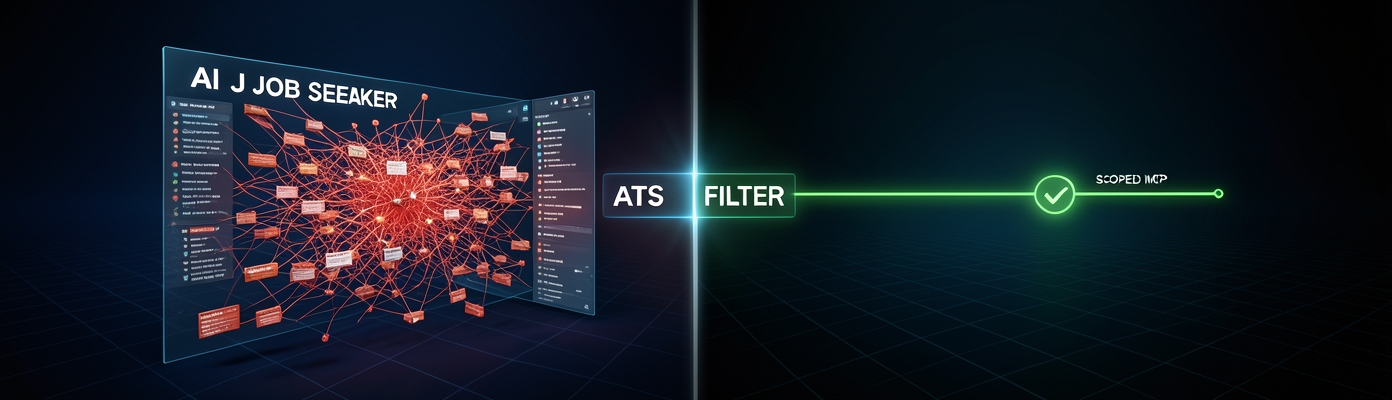
In contrast, MCP scoping filters the visible tool inventory down to what the workflow needs.
In permission-scoped scenarios (identity-based), some implementations have shown tool visibility reductions by more than 90%. When tool count drops, tool schema tokens drop too, because the model sees fewer tool definitions.
This matters directly for MCP tool scoping for AI agents token cost:
– fewer tool schemas in prompt context
– fewer competing tool call options
– less “thinking about tools” overhead during each generation turn
For job seekers, lower token cost enables higher iteration counts—more practice loops, more feedback cycles, and faster refinement of ATS-aligned phrasing.
Insight: HR concerns behind the ATS and automation story
HR leaders often frame ATS and automation concerns around fairness and compliance. But the deeper friction is security and governance—especially identity-scoped tool behavior and runtime enforcement.
What HR may avoid saying explicitly: some applicants can leverage agentic scoping advantages that the organization doesn’t enforce internally—or that consumer tools don’t restrict as tightly.
When tool visibility and permissions aren’t governed, the agent can:
– request unauthorized actions
– attempt unsafe steps
– generate artifacts that don’t match internal workflow requirements
The other risk is that failures can happen after costly prompt processing. Even if the system later blocks the tool call, tokens may already have been consumed.
A mature governance pattern includes runtime scope checks before tool execution. Even after scoping tool lists, the system should verify permissions again at the moment of action.
This reduces the blast radius of:
– model misbehavior
– prompt injection attempts
– stale permission contexts
In other words, it’s not enough to filter tools at build time. You also need execution-time enforcement.
5 Benefits of MCP tool scoping for interview automation
When interview automation is governed with MCP-aware scoping, the outcome is not only safer behavior but improved ROI. Here are five benefits that job seekers (and HR teams) should care about.
MCP tool scoping helps because it aligns three factors:
– token cost control (MCP tool scoping for AI agents token cost)
– reduced prompt overhead (prompt overhead reduction)
– safer behavior via tool visibility constraints (least-privilege tool visibility)
Fewer visible tools means fewer schema tokens each turn.
Scoped tool sets reduce “wrong tool” generation and downstream formatting mismatch.
When the workflow is consistent, job seekers can maintain stable keyword/competency alignment across sessions.
Identity-scoped access reduces risk of unauthorized actions.
For HR-facing evaluation tooling, governed agents are easier to operate and audit because tool visibility is predictable.
Forecast: where job seekers, agents, and governance are heading
This isn’t just a transient trend. The next wave of interview automation is becoming governance-aware—because cost and compliance are converging into the same technical mechanism: scoped tool visibility and identity-entitled actions.
The future playbook will resemble how enterprises run production systems: least privilege, scoping, runtime checks, and cost-aware context assembly.
Expect more agent templates that:
– implement Model Context Protocol tool scoping
– enforce least-privilege tool visibility
– map tools to entitlements per identity
– reduce prompt overhead reduction by limiting schema exposure
This leads to a competitive advantage for job seekers who iterate more without blowing budgets—and a competitive disadvantage for employers who dismiss governance as “not relevant to hiring.”
Identity governance will become part of the interview ecosystem. Not because HR wants it, but because cost and risk models demand it.
As agents become more tool-capable, prompt injection becomes a practical threat: a malicious instruction could attempt to get the agent to perform unintended actions.
Security patterns are already migrating into everyday automation.
A common mitigation pattern:
– user confirmation steps before major actions (submitting forms, sending emails, downloading documents)
– explicit “review first” gates when tools are about to execute
This is the intersection of usability and control. It prevents agents from running risky tool calls even when the model is tricked.
In practical interview automation, those gates can look like:
– “Review your final response” before sending
– “Confirm before uploading” before document generation
– “Approve before sending follow-up”
The ROI is straightforward: fewer catastrophic mistakes and fewer wasted tokens caused by reruns after failed executions.
Call to Action: implement MCP-aware identity controls now
If you’re an HR team or an platform owner supporting hiring automation, you can’t treat MCP scoping as an abstract security concept. It directly impacts cost, reliability, and risk.
For job seekers, governed setups are also the fastest path to sustainable iteration.
Start with identity foundations: create an agent identity whose entitlements map to exactly the interview automation tasks you want.
Operational steps:
1. Define tool categories needed for interview preparation (drafting, formatting, scheduling)
2. Map those tools to entitlements for the agent identity
3. Generate the MCP tool list from that entitlement map before any model call
4. Ensure unrelated tools are not visible to the agent
This is the most direct way to realize MCP tool scoping for AI agents token cost and enforce least-privilege tool visibility.
Then enforce at execution time.
Implement a runtime check that validates:
– the calling identity
– the requested tool
– the parameters and target resources
– whether the action is permitted in the current context
This turns “filtering” into “enforcement,” and it protects against:
– prompt injection
– tool list drift
– mis-scoped intermediate reasoning
Conclusion: win the interview with governed automation
Interview automation is moving beyond “write me an answer.” The winners are building governed agent systems that control tool visibility, minimize token waste, and prevent unsafe actions.
– MCP tool scoping for AI agents token cost reduces prompt overhead by shrinking tool schema exposure.
– Model Context Protocol enables structured tool access—but unmanaged tool lists create “tool tax.”
– Identity governance with least-privilege tool visibility improves both cost and safety.
– Runtime authorization checks reduce risk even when the model behaves unexpectedly.
For job seekers, governed automation means more iteration, lower cost, and more consistent ATS-adjacent alignment. For HR and platforms, the path forward is to stop treating these controls as purely security work—because the same mechanisms drive ROI in reliability, cost, and auditability.