
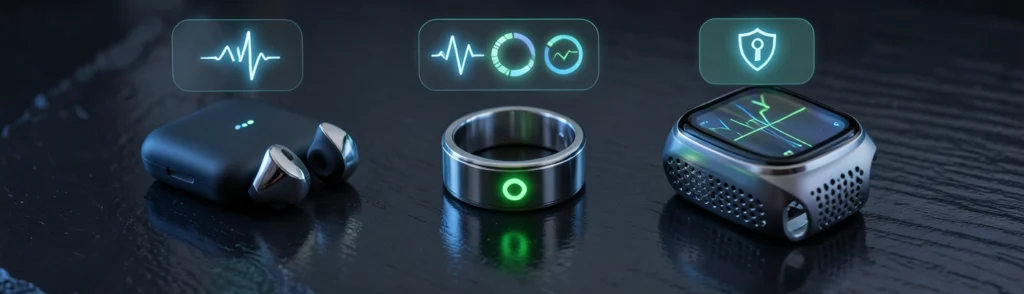

Intro: Choose the Right Wearables for Health Tracking
Choosing among today’s wearables for health tracking is no longer simply a question of picking the device with the most sensors. In 2026, smart rings, smartwatches, and open earbuds each serve a different purpose. One may be ideal for sleep and recovery, another for live exercise data, and a third for audio coaching without blocking environmental sounds.
The best choice depends on how you want health information to fit into your day. Do you want a screen-free device that quietly monitors trends? Do you need GPS, workout metrics, calls, and notifications on your wrist? Or would you rather combine fitness earbuds with hands-free guidance and better awareness outdoors?
Privacy is equally important. Health wearables collect information about movement, heart rate, sleep, location, stress, and sometimes temperature or blood oxygen. That data may be stored on the device, processed in a companion app, uploaded to the cloud, or used to personalize recommendations. A device can be accurate and convenient while still offering weak control over personal information.
Wearables for health tracking are connected devices that use sensors to monitor physical activity and physiological signals. They include:
- Smart rings designed for passive, screen-free monitoring
- Smartwatches that combine health tools with interactive features
- Fitness earbuds that provide audio feedback, movement stability, and environmental awareness
Most consumer wearables estimate rather than directly diagnose. For example, a ring may infer sleep stages from movement, heart rate, heart-rate variability, breathing patterns, and temperature. A smartwatch may estimate training load from heart rate and GPS movement. These insights can be useful, but they should not replace professional medical advice or clinical testing.
Passive Activity and Health Monitoring
A wearable can collect information without requiring you to start an app every few hours. This is especially useful for tracking everyday movement, resting heart rate, exercise frequency, and periods of inactivity.
A smart ring works like a quiet notebook that records the background details of your day. You may not notice it while walking, working, or sleeping, but the companion app can reveal patterns over time. Smartwatches provide similar monitoring, although their larger screens encourage more frequent interaction.
Sleep and Recovery Insights
Sleep tracking is one of the strongest reasons to choose a smart ring. Rings are lightweight, screen-free, and generally comfortable to wear overnight. They can track sleep duration, nighttime heart rate, temperature trends, breathing patterns, and recovery indicators.
Smartwatches can also provide valuable sleep data, but comfort and battery life may become obstacles. Charging a watch overnight means losing the very data it is supposed to collect. Earbuds are less suitable for continuous sleep tracking because they can be uncomfortable, fall out, or require more frequent charging.
Real-Time Exercise Feedback
Smartwatches remain the strongest option for live exercise feedback. They can display heart rate, pace, distance, route maps, intervals, elevation, and training zones while you exercise. Built-in GPS is particularly useful for runners, cyclists, hikers, and outdoor athletes.
Fitness earbuds can complement a watch by delivering spoken pace updates or coaching prompts. A smart ring, by comparison, usually focuses on post-workout summaries rather than detailed data during the session.
Personalized Coaching
Wearable apps increasingly turn raw sensor readings into recommendations. Instead of only reporting that you slept seven hours, an app may suggest adjusting your training intensity after a poor night’s sleep. It may also identify recurring patterns between late meals, stress, exercise, and sleep quality.
The quality of this coaching depends on the underlying data, the software model, and how clearly the app explains its recommendations. A readiness score should be treated as a planning aid, not an unquestionable verdict.
Early Awareness of Health Trends
Wearables can help you notice changes in your normal baseline. A sustained increase in resting heart rate, repeated sleep disruption, or a gradual decline in activity may encourage you to investigate your habits or speak with a healthcare professional.
This is similar to a dashboard warning light in a car. It does not tell you exactly what has gone wrong, but it may indicate that something deserves attention. Short-term fluctuations are common, so longer trends are generally more useful than one unusual reading.
| Device | Best for | Main strength | Main limitation |
|---|---|---|---|
| Smart ring | Sleep and recovery | Discreet passive tracking | Limited live feedback |
| Smartwatch | Training and connectivity | GPS, screen, broad features | Frequent charging |
| Open earbuds | Audio and awareness | Coaching while hearing surroundings | Fewer health metrics |
The simplest comparison is this: smart rings prioritize passive insight, smartwatches prioritize interaction, and open earbuds prioritize audio and situational awareness. Many users may ultimately combine two devices rather than expect one product to do everything.
Background: How Health Wearables Collect and Protect Data
The value of a wearable depends on two factors: what it can measure and how responsibly it handles the information it collects. Sensor quality matters, but so do fit, software, battery performance, account policies, and privacy controls.
Smart rings use optical sensors, temperature sensors, accelerometers, and sometimes additional sensors to collect data from the finger. Their small form factor makes them less interactive than a smartwatch, but that is part of their appeal.
Common smart ring health tracking features include:
- Heart rate and resting heart rate
- Heart-rate variability
- Sleep duration and sleep stages
- Skin-temperature trends
- Blood oxygen estimates
- Activity and step tracking
- Stress or readiness scores
- Menstrual-cycle and recovery insights
The ring’s advantage is consistency. Because it has no bright display or constant stream of notifications, many people are more willing to wear it day and night. Its limitation is that most rings do not offer a detailed screen, built-in GPS, or rich live workout controls.
A smart ring must fit securely enough for reliable sensor contact without becoming uncomfortable. Finger size changes with heat, cold, exercise, and time of day, so sizing kits are important.
Think of the fit like adjusting a bicycle helmet. Too loose and it moves around; too tight and you will avoid wearing it. A poorly fitted ring can produce inconsistent readings and become irritating during sleep or exercise.
Before buying, check whether the ring works on your preferred finger, whether it is water-resistant, how easily it scratches, and whether the manufacturer supports exchanges after sizing.
Smartwatches use a larger sensor package and display to combine health tracking with communication and navigation. They are closer to a compact phone worn on the wrist than a dedicated passive sensor.
Smartwatch battery life varies significantly. Many general-purpose models last about one to three days, while endurance-focused watches can last much longer. Always-on OLED displays, bright outdoor modes, GPS, music playback, cellular connections, and sleep tracking all consume power.
Display technology matters. OLED screens offer rich colors, high contrast, and smooth animations, but they typically use more energy than memory-in-pixel displays. MIP screens may look less vivid indoors but can be easier to read in sunlight and more efficient during multi-day activities.
Longer battery life is not merely a convenience. It improves data continuity. A watch that needs charging every night may miss sleep data, while a longer-lasting model can provide a more complete view of recovery and training.
A smartwatch is the most versatile choice for people who want live feedback. Depending on the model, it may provide:
- Built-in GPS and route tracking
- Heart-rate zones and workout intervals
- Running power or cycling metrics
- Notifications and message replies
- Calls and voice assistants
- Music controls and offline playback
- Fall detection or emergency features
That flexibility comes with complexity. More features often mean more settings, more battery use, and more data moving between the watch, phone, and cloud services.
Open-ear earbuds sit outside or near the ear canal rather than sealing it completely. They allow users to listen to music, navigation prompts, or coaching while hearing traffic, conversations, and other environmental sounds.
Fitness earbuds need to stay in place through running, jumping, sweating, and head movement. Sport loops, ear hooks, stabilizing wings, and adjustable designs can help.
A secure fit is not only about comfort. If an earbud shifts during a workout, audio balance may change and touch controls may become harder to use. For runners, cyclists, and gym users, a stable design may be more valuable than advanced noise cancellation.
Some open earbuds focus mainly on audio rather than health tracking. They may deliver spoken workout prompts from a connected smartwatch or phone without independently measuring much health data.
Open-ear designs are useful for outdoor exercise because they preserve awareness of surrounding sounds. A runner can hear a bicycle bell, a vehicle, or another person while still receiving music or navigation instructions.
However, open earbuds are not automatically safe in every environment. Loud audio can still mask important sounds, and wind noise may reduce clarity. Users should keep volume moderate and choose products that remain stable without pressing painfully against the ear.
Wearable privacy includes more than whether a device has a privacy policy. It covers what is collected, where it is processed, who can access it, how long it is retained, and whether you can delete or export it.
Review permissions for location, contacts, microphone access, notifications, health data, and background activity. A fitness app may need location for GPS workouts, but it may not need access to every contact on your phone.
On-device processing generally reduces exposure because raw data does not always need to leave the wearable. Cloud processing can support richer AI features, but it also creates another place where personal data is stored.
Some products require a subscription for advanced sleep, readiness, coaching, or historical reports. Others provide core tracking without recurring fees. Neither model is automatically better, but the total cost should be clear before purchase.
Look for controls that allow you to:
- Export your health data
- Delete your account and stored records
- Disable advertising or research sharing
- Limit third-party integrations
- Manage family or clinician access
- Turn off cloud backups where possible
A wearable with fewer features but clearer controls may be the better privacy choice.
Trend: What Is Changing in Wearables for Health Tracking in 2026?
The wearables market is moving toward less interruption, more interpretation, and stronger competition around data ownership.
Sensors are becoming smaller and more power-efficient. This allows rings and other compact devices to collect more information without adding bulk.
The direction is similar to smartphones losing physical buttons while gaining more software capability. The hardware becomes less noticeable, but the amount of background information increases. That makes transparency and user control more important.
AI is increasingly used to translate measurements into practical suggestions. Instead of showing a chart of heart-rate variability, an app might recommend a lighter workout, earlier bedtime, or additional recovery time.
These systems can be helpful when they explain the reasoning behind a recommendation. They are less useful when they present a score without context. Users should be able to distinguish between measured data, estimated data, and algorithmic interpretation.
Battery improvements will remain a major selling point because continuous tracking depends on consistent wear.
Many smart rings target approximately five to nine days of battery life, depending on features and usage. Charging cases, faster charging, and better low-power sensors can reduce interruptions.
A ring that lasts a week behaves more like a household appliance than a phone. You charge it occasionally rather than organizing your entire routine around its battery.
Smartwatch battery life will continue to vary according to display technology and intended use. OLED models are likely to become more efficient, while MIP and solar-assisted designs will remain attractive for endurance users.
Future watches may combine bright OLED panels with better power management, adaptive refresh rates, improved solar charging, or larger batteries. However, physics will continue to impose trade-offs: a brighter, more interactive screen generally requires more energy.
Open-ear earbuds are becoming more visible in exercise and outdoor audio. Their appeal is strongest for users who want podcasts, music, navigation, and coaching without fully isolating themselves.
The category may expand through sport-focused designs with loops, improved wind handling, better water resistance, and more reliable voice controls. They are unlikely to replace smart rings or watches for detailed health tracking, but they can become an important companion device.
Consumers are paying closer attention to subscription fees, data sharing, and cloud storage. In response, manufacturers may offer more local processing, clearer consent screens, and easier deletion tools.
Privacy could become a competitive feature in the same way battery life and water resistance are today. A company that explains its data practices clearly may gain trust even if its device has fewer headline features.
Insight: Smart Ring vs. Smartwatch vs. Open Earbuds
Smart rings are the strongest choice for people who want passive monitoring without a screen.
- Comfortable for overnight use
- Typically longer battery life than smartwatches
- Discreet and lightweight
- Strong focus on sleep and recovery
- Minimal notifications and distractions
- Often compatible with broader daily routines
A ring is like a background accountant: it quietly records patterns and presents a summary later.
- Limited or no live workout display
- Usually no built-in GPS
- Small form factor can restrict sensor capacity
- Fit and sizing are critical
- Some advanced insights require subscriptions
- Accuracy may vary across activities and users
Smart rings are not ideal for athletes who need pace, route, interval, or navigation data during exercise.
Smartwatches remain the most complete all-purpose option.
- Detailed live workout metrics
- Built-in GPS on many models
- Notifications, calls, and music
- Broad health and safety features
- Easy access to charts and settings
- Strong integration with phones and fitness apps
A smartwatch is like a car dashboard: it gives you information immediately and lets you control several systems from one place.
- More frequent charging
- Larger and more noticeable on the wrist
- Screen notifications can be distracting
- OLED models may consume significant power
- Some health features depend on phone or ecosystem compatibility
- More connected features can increase privacy exposure
If smartwatch battery life is your main concern, compare real-world results with GPS and always-on display enabled rather than relying only on manufacturer estimates.
- Hear surroundings while listening
- Useful for running, walking, and cycling
- Hands-free coaching and navigation
- Less isolating than sealed earbuds
- Lightweight options for active use
- Can complement a ring or smartwatch
Open earbuds are especially useful when information should reach you without requiring you to look at a screen.
- Usually provide fewer independent health measurements
- Sound quality can be affected by wind and traffic
- May leak audio in quiet spaces
- Secure fit varies between ears
- Battery life is usually shorter than a ring’s
- They may depend on a phone or smartwatch for coaching data
Smart rings often collect extensive sleep and physiological data. Smartwatches may collect the broadest combination of health, location, communication, and activity information. Open earbuds generally collect less health data but may access microphones, voice assistants, device identifiers, and location through companion apps.
The most private device is not necessarily the one with the fewest sensors. It is the one that gives you control over what those sensors collect and how the information is used.
Review whether the app requires an account, whether data is uploaded automatically, and whether third-party services receive access. Check if health information can be exported in a standard format.
A device can be technically secure while its business model still depends heavily on cloud analytics. Read the account and privacy settings before connecting the wearable to other platforms.
Subscriptions can create an ongoing cost and may determine whether you receive basic metrics or detailed insights. Calculate the price over two or three years, not just the initial purchase price.
Choose a smart ring if your priorities are sleep, recovery, comfort, low distraction, and long battery life. It is particularly suitable for users who want trends rather than constant live feedback.
Choose a smartwatch if you need GPS, training zones, calls, messages, navigation, or on-device workout controls. It is the most practical single device for people who want both health tracking and general connectivity.
Choose open earbuds if you exercise outdoors and want music, podcasts, navigation, or spoken coaching while preserving awareness. They work best as a companion to another health wearable rather than a replacement for one.
Forecast: The Future of Private Wearables for Health Tracking
Smart rings are likely to become the preferred form factor for sleep and recovery tracking, but they will not fully replace smartwatches. The two devices solve different problems.
Rings are better suited to passive overnight wear. Watches remain better for workouts, navigation, notifications, and safety features. The future may involve automatic data sharing between both devices, with the ring handling nighttime monitoring and the watch taking over during training.
Yes, but progress will be incremental. More efficient OLED panels, adaptive refresh rates, better processors, software limits, and improved batteries should extend runtime.
Endurance watches will continue to use efficiency-focused displays or solar assistance where multi-day battery life matters most. Premium general-purpose watches may offer a choice between vivid screens and extended runtime rather than eliminating the trade-off entirely.
Some fitness earbuds may add sensors for heart rate, temperature, motion, or exertion. However, the ear is a challenging location for accurate measurements during movement, and earbuds face strict limits on size, comfort, heat, and battery capacity.
The most likely near-term development is better integration with watches and phones. Earbuds may become the audio interface for health data collected elsewhere.
On-device AI could analyze more health information without sending raw data to the cloud. This would improve privacy and reduce dependence on an internet connection.
The challenge is computational power. Smaller devices have limited energy and processing capacity, so manufacturers will need efficient models that provide useful results without draining the battery.
Future platforms may offer clearer data dashboards where users can see what was collected, which insights were generated, and where information was shared. One-click export and deletion could become expected features.
This would shift the relationship from “the company holds your data” to “you manage a personal health record.” That change could influence purchasing decisions as strongly as accuracy or design.
Look for transparent testing, consistent performance across activities, and clear explanations of estimated metrics. Do not assume that a larger number of sensors automatically means better accuracy.
Check real-world battery life with your intended features enabled. Ask how long charging takes and whether a short charge can restore enough power for overnight tracking.
Confirm compatibility with your phone, preferred health platform, fitness apps, and possible future devices. A wearable that works beautifully inside one ecosystem may become frustrating if you switch platforms.
Include subscriptions, replacement chargers, sizing kits, accessories, premium app tiers, and likely replacement cycles. A lower purchase price may not remain lower over several years.
Call to Action: Build a More Private Health-Tracking Setup
Open the companion app and review location, microphone, contacts, health-data sharing, cloud backup, and third-party connections. Disable permissions that are not necessary for the features you use.
Choose three priorities, such as:
- Better sleep consistency
- More structured running
- Greater awareness during outdoor exercise
This prevents you from paying for features that do not solve a real problem.
Evaluate comfort and data controls alongside sensor features. A device that stays charged, fits correctly, and protects your information will usually be more useful than one with a longer specification sheet.
If you struggle to understand your sleep, start with a smart ring. If you need live training data, choose a smartwatch. If you want audio coaching without losing environmental awareness, try open earbuds.
Conclusion: Find the Best Wearables for Health Tracking in 2026
Smart rings are best for discreet, passive monitoring, especially sleep and recovery. Smartwatches are the most capable all-around option for workouts, GPS, communication, and live feedback. Open earbuds are best for audio coaching, navigation, and outdoor awareness.
There is no universal winner. The right device depends on whether you value quiet background tracking, immediate interactive information, or hands-free audio.
The best wearables for health tracking are not necessarily those with the most sensors. They are the ones you will wear consistently, understand easily, charge reliably, and trust with personal information.
In 2026, compare smart ring health tracking, smartwatch battery life, fitness earbuds, and wearable privacy as connected buying decisions. A comfortable ring may reveal recovery trends. A powerful watch may transform training. Open earbuds may make outdoor exercise more practical. Choose the device—or combination of devices—that supports your daily habits without demanding more data, attention, or money than it is worth.