
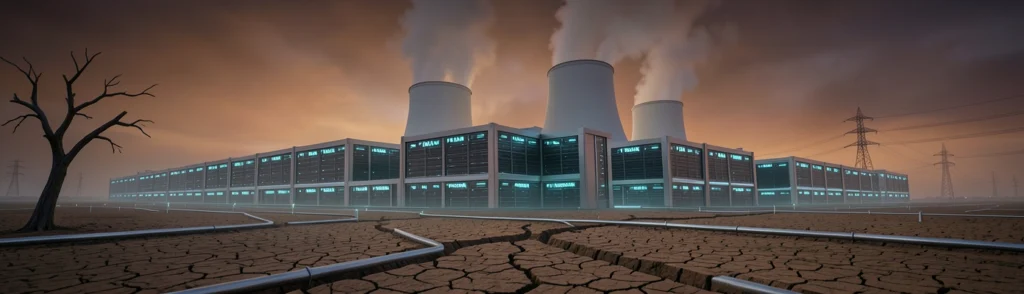

Intro: Why AI Data Center Environmental Impact Matters
Artificial intelligence is often presented as software: a model, an app, or a virtual assistant operating somewhere in the cloud. But every AI response depends on physical infrastructure. Behind the interface are data centers packed with processors, cooling systems, backup generators, electrical equipment, water pipes, and miles of transmission lines.
That infrastructure is expanding rapidly. Companies are building larger facilities to train increasingly capable models and serve billions of AI queries. The result is a growing public debate over the AI data center environmental impact—particularly its demand for electricity, its consumption of water, and the emissions associated with construction and power generation.
The industry argues that AI data centers will bring jobs, tax revenue, technological leadership, and new infrastructure investment. Critics counter that the benefits may be concentrated among technology companies while the costs fall on residents through higher utility bills, strained water supplies, pollution, noise, and land conversion.
The political risk is becoming harder to ignore. In communities across the United States, residents and local officials are challenging proposed projects, seeking megawatt limits, demanding disclosure, and sometimes campaigning against candidates who support unchecked development. The dispute is no longer simply about climate policy. It is about who controls local resources—and who gets to decide what the AI economy is allowed to consume.
AI data center environmental impact refers to the environmental consequences of constructing and operating facilities used to train, deploy, and support artificial intelligence systems.
Those consequences include:
- Electricity consumption and associated carbon emissions
- Water used for cooling and power generation
- Air pollution from natural-gas turbines and diesel backup generators
- Mining and manufacturing impacts from servers, chips, batteries, and construction materials
- Land disturbance, noise, and traffic
- Pressure on local utility systems and public infrastructure
A useful analogy is to think of an AI model as an industrial product rather than a purely digital service. A search query may feel weightless, but the servers processing it require power and cooling every second. Training a major model resembles building a factory that operates continuously, while serving the model resembles running that factory at high speed for customers around the world.
Not all facilities have the same footprint. A small colocation site in a region with abundant renewable power and recycled cooling water may create fewer local impacts than a hyperscale campus powered by fossil fuels and located in a drought-prone area. The location, energy mix, cooling design, workload, and construction timeline all matter.
Electricity, water, and emissions are the three pressure points at the center of the controversy.
AI processors are exceptionally power-hungry, and dense computing equipment generates substantial heat. More electricity is required not only for servers but also for cooling, networking, backup systems, and facility operations. If that power comes from coal or natural gas, data center energy demand can increase regional emissions even when the facility itself claims to purchase renewable energy certificates.
Water creates a different kind of conflict. Residents may accept an energy-intensive project in theory but object when it draws millions of gallons from a stressed aquifer, river system, or municipal supply. In a drought, the question becomes politically explosive: should drinking water, agriculture, ecosystems, or AI infrastructure receive priority?
The public is also questioning whether promised economic benefits justify these costs. If a project creates relatively few permanent jobs but requires a new power plant, transmission corridor, highway expansion, and water treatment facility, the financial balance may be less attractive than promotional materials suggest.
Background: How AI Infrastructure Creates Environmental Pressure
AI infrastructure creates environmental pressure because its growth is fast, concentrated, and difficult for traditional utility planning to absorb. Power systems were designed around gradual changes in demand. AI campuses can request hundreds of megawatts almost at once, forcing utilities to reconsider generation, transmission, and capacity planning.
Global data center energy demand is rising as cloud computing, video services, cryptocurrency mining, and AI workloads expand. AI adds a particularly intense layer because advanced processors consume more electricity and are often deployed in dense clusters.
Training an AI model involves running thousands of processors simultaneously for weeks or months. After training, the model must handle inference—the process of generating answers, images, code, or predictions for users. Inference can continue around the clock and may eventually consume more electricity than the original training run.
An analogy helps clarify the difference. Training is like teaching an enormous class in an intensive semester. Inference is like operating a global examination center every day afterward. Even if each individual interaction is small, billions of interactions create a substantial cumulative load.
AI chips also generate more heat than conventional servers. Cooling systems therefore consume additional energy, especially when operators maintain strict temperature and humidity conditions to protect expensive equipment.
Renewable energy is expanding, but it is not always being built as quickly as AI companies want new capacity. Transmission lines can take years to permit and construct. Wind and solar resources may be located far from data center clusters. Battery storage remains limited for sustained, round-the-clock demand.
These constraints can encourage utilities or developers to use natural-gas turbines, including so-called behind-the-meter generation. Gas is less carbon-intensive than coal, but it still produces substantial greenhouse-gas emissions and can contribute to nitrogen oxide pollution. If construction delays affect turbines, transformers, or transmission equipment, fossil-fuel use may persist longer than planned.
Some industry assessments have warned that AI expansion could undermine recent power-sector emissions reductions if new data centers are supplied primarily by gas. The exact outcome depends on project cancellations, renewable deployment, regulatory requirements, and the speed of grid modernization.
Data center water usage is the amount of water consumed or withdrawn to cool servers, operate cooling towers, humidify air, and support associated power infrastructure.
Water consumption refers to water that is not immediately returned to its original source, often because it evaporates. Water withdrawal refers to water taken from a river, reservoir, aquifer, or municipal system, even if some is later discharged.
Many data centers use evaporative cooling. In simple terms, the system uses water evaporation to remove heat from the facility. This can be energy-efficient, but it can also create a substantial water footprint during hot periods or heavy computing demand.
Other facilities rely on air cooling, chilled-water systems, direct-to-chip liquid cooling, or closed-loop designs. None is automatically impact-free. Air cooling may require more electricity, while liquid systems can involve significant equipment and maintenance. A closed-loop system can greatly reduce ongoing consumption, but it may require more capital and still depend on water during initial filling or maintenance.
The trade-off resembles choosing between a fuel-efficient car and a larger vehicle: reducing one form of consumption can increase another. The relevant question is not whether a system has a single “green” label, but how it performs under local conditions.
A data center located in a water-rich region may have a different impact from one located in a drought-prone watershed. Even a project using a modest share of total regional water can generate opposition if residents face restrictions, rising rates, or declining groundwater levels.
Water availability is also seasonal. A facility may appear sustainable based on annual averages but create serious pressure during heat waves, droughts, or peak agricultural demand. Communities increasingly want developers to disclose monthly water use, source water, discharge plans, and emergency restrictions.
Measuring AI infrastructure emissions is more complicated than counting electricity use. A credible assessment must account for the full lifecycle of the facility and equipment.
Direct emissions come from on-site sources such as diesel generators, natural-gas turbines, refrigerant leakage, and fuel combustion.
Indirect emissions arise from purchased electricity. A data center drawing power from a fossil-heavy grid can have a larger carbon footprint than an identical facility connected to a cleaner grid. However, contractual renewable purchases do not necessarily mean every hour of consumption is matched with new clean generation.
Construction emissions include concrete, steel, excavation, transportation, semiconductor manufacturing, server production, batteries, and cooling equipment. These so-called embodied emissions can be significant before a facility processes its first AI request.
Renewable energy can reduce operational emissions, but the quality of the claim matters. A company may purchase renewable energy certificates while consuming grid electricity generated partly by gas. That arrangement can support clean-energy development, but it does not always reduce local or hourly emissions.
Stronger approaches include new renewable projects, long-term power purchase agreements, energy storage, hourly carbon accounting, and firm clean power that can operate when wind and solar output falls.
Trend: Rising Energy Demand and Community Opposition
Data center energy demand is becoming a planning issue for utilities, regulators, and residents. A large campus can consume as much electricity as a small city, but its load may arrive in a single industrial zone.
Grid interconnection queues are growing in many regions. Developers may face delays obtaining transformers, substations, and transmission capacity. Utilities may respond by proposing new gas plants or extending the life of existing fossil-fuel facilities.
The danger is that temporary reliability measures become permanent infrastructure. A gas plant built to serve AI growth may operate for decades, locking in emissions long after the original forecast changes.
Utilities typically recover infrastructure costs through rates. If contracts do not protect consumers, households and small businesses may help pay for substations, pipelines, generation, or transmission upgrades built primarily for large technology customers.
Some utilities negotiate special tariffs or require data centers to pay upfront costs. These protections can reduce cross-subsidization, but they must be transparent and enforceable. Otherwise, a project advertised as an economic engine can become a long-term public obligation.
Community opposition to data centers often begins with local concerns rather than opposition to AI itself. Residents may ask why an industrial-scale facility belongs near homes, farms, schools, or wetlands.
Common complaints include:
- Unclear water-use estimates
- Noise from cooling systems and generators
- Construction traffic and road damage
- Loss of farmland or natural areas
- Higher electricity rates
- Few permanent jobs
- Limited public input
- Tax incentives that reduce expected revenue
The political message is straightforward: communities want proof that the benefits are real and locally distributed.
Some municipalities are considering temporary moratoriums, zoning restrictions, noise standards, water conditions, or limits on electricity consumption. Others are challenging permits through public hearings, environmental reviews, and litigation.
These disputes can become especially intense where state law limits local zoning authority or where projects are located outside city boundaries. Developers may also claim vested rights if they secured approvals before new rules were enacted, limiting the ability of governments to apply stricter standards retroactively.
Residents fear that enormous loads will strain the grid, increase blackout risks, or force utilities to build infrastructure before demand is certain.
Gas turbines and diesel generators can produce greenhouse gases and local pollutants. Backup equipment may run during grid emergencies, when air quality is already under pressure.
High data center water usage can compete with households, farms, and ecosystems. The concern is greatest where groundwater is declining or drought restrictions are common.
Cooling fans, generators, substations, lighting, and heavy construction can alter the character of rural and suburban areas. Large campuses may also fragment habitats and increase stormwater runoff.
The public may absorb costs while companies receive tax incentives. If a facility creates limited employment, residents may conclude that the economic bargain is unbalanced.
Insight: Can Data Center Growth Earn Public Trust?
Data centers can create construction employment, property-tax revenue, equipment demand, and improvements to roads or utilities. They may also attract research institutions and technology companies.
But job quality and duration matter. Construction can be labor-intensive, while ongoing operations may require relatively few workers compared with a manufacturing plant. Tax benefits can also be reduced by abatements or special development agreements.
The central accountability question is who pays. Developers should finance the infrastructure directly attributable to their loads, including stranded-capacity risk if projects are delayed or canceled. Communities should not be left with oversized systems built on optimistic forecasts.
Space-based data centers could use continuous sunlight for solar power and avoid consuming scarce terrestrial land or freshwater. Underwater facilities might benefit from naturally cool surroundings and reduce the need for conventional cooling systems.
These concepts remain technologically and economically constrained. Launching heavy computing equipment is expensive, maintenance is difficult, radiation can damage electronics, and hardware upgrades are complicated. Underwater facilities face corrosion, repair, cable, and environmental risks.
Orbital infrastructure is not an escape from environmental accounting. Rocket launches produce emissions, satellites require manufacturing, and large constellations create congestion and debris concerns. For the foreseeable future, terrestrial data centers will remain cheaper and easier to scale.
Data center conflicts expose a tension between local democracy and state economic-development policy. Municipal governments may want control over land use, while state officials may prioritize investment and competitiveness.
Once a project has received approvals or begun construction, later rules may not apply. Vested-rights protections provide legal certainty but can also limit communities’ ability to respond to new information about water, emissions, or grid risks.
Forecast: What Happens to AI Infrastructure Next?
In an optimistic scenario, developers add new renewable generation, storage, transmission, and flexible demand at the same pace as AI campuses. Hourly clean-energy matching becomes standard, and efficient chips reduce power per computation.
In a darker scenario, renewable projects lag, gas turbines fill the gap, and demand forecasts remain inflated. Emissions rise even as companies advertise clean-energy purchases. Some planned projects may ultimately be canceled if AI revenues fail to justify their costs, but infrastructure built in anticipation may remain.
Future projects will increasingly favor recycled wastewater, dry cooling, direct-to-chip systems, and closed-loop designs. These technologies can reduce freshwater demand, although they may increase electricity use or capital costs.
Water scarcity could become a decisive site-selection factor. Regions with abundant clean power but limited water may attract facilities using air or liquid cooling. Regions with water availability but carbon-intensive grids may face stricter emissions requirements.
If AI investment slows, some campuses may be delayed or abandoned. This could reduce future energy demand but create stranded assets and local financial disputes.
Governments may require hourly emissions reporting, water budgets, drought contingency plans, noise controls, and lifecycle assessments. Disclosure alone will not solve the problem, but it can expose projects that rely on vague sustainability claims.
Regional planning can coordinate generation, transmission, water, and land use before projects receive approval. Community benefit agreements can guarantee local hiring, utility protections, conservation funding, and public reporting.
Call to Action: How Stakeholders Can Reduce Environmental Impact
Developers should finance new clean generation and storage rather than relying solely on existing renewable certificates. They should also publish hourly energy data and disclose fossil-fuel backup plans.
Facilities should prioritize recycled water, closed-loop cooling, direct-to-chip systems, and dry cooling where local water stress justifies the trade-off.
Communities need project-specific information, not global sustainability averages. Developers should disclose expected peak demand, annual and seasonal water use, emissions, tax incentives, infrastructure costs, and permanent employment.
Residents should ask who pays for grid upgrades, whether the project has a binding load commitment, and what happens if promised demand never arrives.
Communities should demand source-level water data, withdrawal limits, recycling targets, and restrictions during drought emergencies.
Officials should request enforceable commitments on hiring, taxes, infrastructure funding, noise, conservation, and public reporting—not merely projected economic benefits.
Standards should cover carbon intensity, peak demand, water consumption, backup generation, and cumulative regional impacts.
Residents need meaningful access to technical documents, hearings, independent review, and enforceable appeals. Public consultation should occur before land is optioned and major infrastructure decisions are finalized.
A data center should not be approved in isolation. Permits must account for regional emissions targets, water availability, transmission capacity, and long-term reliability.
Conclusion: Can AI Infrastructure Growth Survive Public Backlash?
AI data centers are not inherently incompatible with environmental progress. But rapid expansion can increase emissions, water stress, and public costs when developers and utilities treat local resources as unlimited.
The central conflict is not technology versus nature. It is private growth versus public accountability. A facility that brings clean power, efficient cooling, transparent finances, and tangible community benefits may earn support. One that depends on new gas generation, scarce water, subsidies, and vague promises will face resistance.
AI infrastructure growth can survive public backlash only if the industry accepts stricter conditions:
- New electricity demand must be matched with credible clean-energy capacity.
- Water use must reflect local scarcity, not national averages.
- Developers must pay their fair share of grid and infrastructure costs.
- Emissions, water consumption, and economic benefits must be publicly verifiable.
- Communities must have meaningful authority before projects become legally irreversible.
The next phase of AI development will therefore be decided not only in laboratories or corporate boardrooms, but in utility commissions, zoning meetings, elections, and drought-affected communities. If the industry wants permission to build at unprecedented scale, it must prove that the future it is constructing does not quietly transfer its environmental bill to everyone else.