
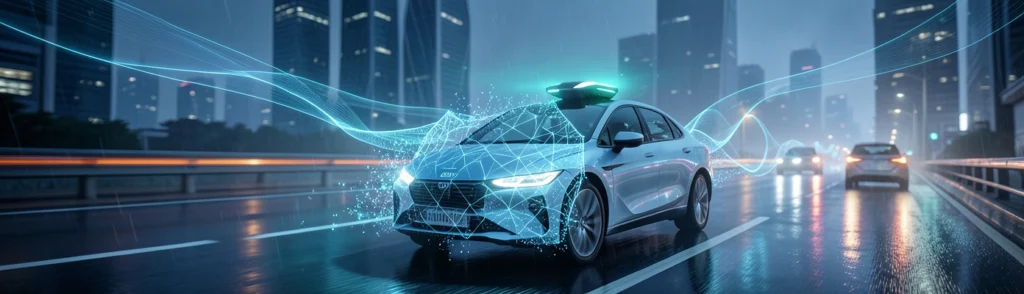

Intro: Why Cooperative Perception Autonomous Driving Matters
Autonomous vehicles are becoming better at understanding the road through cameras, lidar, radar, GPS, high-definition maps, and artificial intelligence. Yet even the most advanced vehicle remains limited by what its own sensors can see.
A delivery van can block a pedestrian. A truck can conceal a stopped car. A sharp bend can hide an approaching cyclist. At a busy intersection, one vehicle may detect a hazard that is invisible to every other vehicle nearby.
Cooperative perception autonomous driving offers a way to overcome this limitation. Instead of treating every vehicle as an isolated robot, cooperative perception allows vehicles, roadside infrastructure, traffic signals, and emergency responders to share selected observations. This creates a wider and more timely understanding of the road.
The idea resembles people coordinating during an emergency. One person may see smoke from a side street, another may hear an alarm, and a third may know that a dangerous intersection lies ahead. Together, they form a more complete picture than any individual could create alone.
This shared intelligence could make driving safer, smoother, and more efficient. However, it also introduces an important question: How much personal information should vehicles exchange in order to perceive the road collectively?
Cooperative perception autonomous driving is an approach in which connected vehicles and infrastructure exchange information about objects, hazards, movement, and road conditions.
A vehicle may share that it has detected:
- A pedestrian near a crosswalk
- A vehicle braking suddenly
- Ice or debris on the road
- A cyclist approaching from behind
- A traffic signal that is about to change
- An emergency vehicle moving through an intersection
The receiving vehicle does not necessarily need the originating vehicle’s raw camera footage. It may only need a structured message describing the observation, its location, direction, timing, confidence, and uncertainty.
This distinction matters. Sharing a short-lived description such as “object moving into lane at estimated speed” is very different from continuously broadcasting high-resolution video containing faces, license plates, homes, and passengers.
Collective awareness for self-driving cars can improve safety, but every shared observation may also reveal something about people and their behavior.
A message about a nearby pedestrian could expose a person’s location. A series of vehicle messages could reveal a commuter’s daily route. Raw sensor data might capture a child entering a home, a person visiting a medical facility, or a passenger inside a vehicle.
The central challenge is therefore not whether vehicles should communicate. It is how they should communicate without turning roads into persistent surveillance networks.
Background: How Cooperative Perception Autonomous Driving Works
Traditional autonomous driving follows a largely vehicle-centered pipeline:
Sensors → Perception → Prediction → Planning → Control
Cameras and lidar collect observations. Software identifies objects and road features. Prediction models estimate what those objects may do next. Planning systems select a maneuver, and vehicle controls execute it.
Cooperative perception adds a communication layer. A vehicle still processes its own sensors locally, but it can also receive observations from nearby participants. The resulting system combines first-hand perception with external evidence.
For example, a car approaching a blind intersection might not see a cyclist behind a parked truck. A vehicle traveling on the cross street could send an alert. The approaching car can then slow down before its own sensors detect the cyclist.
Vehicle-to-vehicle communication allows cars to exchange information directly or through nearby communication infrastructure. Vehicle-to-everything, or V2X, expands this network to include traffic lights, road units, pedestrians’ devices, emergency vehicles, and cloud-supported services.
A useful V2X message might include:
- Object type
- Approximate position
- Speed and direction
- Time of observation
- Confidence level
- Sensor category
- Expected duration
- Message origin and authentication status
The message should provide evidence rather than claim absolute truth. A vehicle reporting a possible obstruction is not commanding every nearby vehicle to brake. Each recipient must evaluate the report alongside its own sensors, maps, traffic rules, and safety policies.
Different sensors provide different forms of evidence. Cameras are valuable for signs, lane markings, colors, and human activity. Lidar can estimate three-dimensional shape and distance. Radar performs well in poor visibility and can measure motion. Infrastructure sensors may offer a fixed, elevated view of an intersection.
Combining these sources is similar to assembling a puzzle. One piece may show an object’s shape, another may reveal its speed, and a third may explain how it is moving through the scene.
However, transmitting raw sensor streams creates substantial privacy and security risks. A privacy-preserving V2X architecture should favor processed, relevant, and limited information over indiscriminate data sharing.
Collective awareness emerges when multiple participants contribute partial observations to a common understanding of the environment.
A vehicle might report a stopped car. A traffic signal could provide timing information. A second vehicle may confirm that traffic is slowing. Together, these messages help nearby autonomous systems anticipate congestion or a collision risk earlier than local perception alone would allow.
The goal is not to create one centralized brain controlling every vehicle. It is closer to a group of independent professionals sharing verified observations while retaining responsibility for their own decisions.
Individual perception gives a vehicle direct control over its sensing and decision-making. It can operate even when connectivity is unavailable, which is essential for safety.
Cooperative perception extends the vehicle’s informational horizon. It can reduce blind spots, improve anticipation, and support earlier responses. But it also creates dependencies on communication networks, message quality, and cybersecurity.
| Capability | Local autonomy | Cooperative perception |
|---|---|---|
| Primary information source | Onboard sensors | Onboard and external observations |
| Privacy exposure | More limited to the vehicle | Potentially broader across networks |
| Blind-spot awareness | Restricted by road geometry | Improved through shared views |
| Connectivity requirement | Low | Moderate to high |
| Cybersecurity exposure | Vehicle-focused | Vehicle, network, infrastructure, and identity systems |
| Failure behavior | Continues local operation | Must gracefully fall back to local operation |
The safest design is not one that replaces local autonomy with network authority. It is one that uses external information as carefully evaluated evidence.
Trend: The Growing Privacy Risks of Connected Autonomous Vehicles
Connected autonomous vehicles can generate enormous amounts of information. Even when data is collected for safety, it may reveal where people go, when they travel, who accompanies them, and what they encounter.
The risk grows when data is retained for long periods, linked across journeys, or shared with organizations that were not part of the original safety purpose.
A single anonymous observation may seem harmless. Thousands of observations can become identifying when combined. This is similar to removing names from a diary while preserving exact dates, locations, and routines. The identity may be reconstructed from the pattern.
If every V2X message contains a stable vehicle identifier, observers could track a car across neighborhoods and over time. Even without a person’s name, a repeated route between a residence, workplace, school, or clinic can reveal identity.
Persistent identifiers may also allow commercial entities to build detailed mobility profiles. A vehicle’s location history could become a valuable product for advertisers, insurers, landlords, or data brokers.
Raw cameras can capture faces, license plates, passengers, children, front yards, windows, and private activities. Lidar can reveal the shape of people and buildings. Audio-capable systems may capture conversations or other sensitive sounds.
The problem is not limited to drivers who agree to connected services. Pedestrians, cyclists, passengers, and residents near roads may be recorded without meaningful consent.
Vehicle data can reveal more than location. It may indicate habits and circumstances, including:
- Frequent visits to hospitals or places of worship
- School drop-off routines
- Night-shift employment
- Attendance at political events
- Social relationships based on repeated co-travel
- Changes in routine that suggest illness, relocation, or emergencies
These inferences can be made even when no message explicitly states them.
Automakers may share data with mapping providers, insurers, fleet operators, advertisers, law enforcement agencies, or infrastructure vendors. Data collected for collision prevention could gradually become part of a broader behavioral surveillance ecosystem.
Purpose expansion is a major concern. A system introduced to warn about hazards might later be used to evaluate driving style, sell location-based advertising, or calculate insurance premiums.
Attackers could exploit V2X systems to impersonate vehicles, inject false hazards, replay old messages, or track participants. A malicious actor might broadcast a phantom obstacle and cause unnecessary braking. Another could suppress a legitimate warning.
This makes autonomous vehicle cybersecurity inseparable from privacy. Weak authentication can expose identities, while poorly protected communication can compromise both safety and confidentiality.
Raw sensor sharing creates a larger technical and legal footprint. Video, lidar point clouds, radar traces, and audio require more bandwidth, storage, access controls, and processing services.
Every additional copy of raw data becomes another potential breach point. A compromised vehicle, roadside unit, cloud account, or analytics provider could expose information far beyond the original safety event.
Raw data also creates difficult retention questions. If a vehicle records an entire journey to support future algorithm training, the organization may retain far more personal information than was needed to address a specific hazard.
Insight: How Privacy-Preserving V2X Could Solve These Risks
Privacy-preserving V2X is a communication architecture designed to support road safety while limiting unnecessary identification, collection, retention, and sharing of personal data.
Its principles include:
- Share the minimum data needed for a defined safety purpose
- Process sensitive information locally whenever possible
- Use temporary identifiers instead of permanent identities
- Authenticate messages without exposing personal identity
- Limit where and how long data remains useful
- Delete or transform data when the safety purpose ends
The objective is not perfect anonymity in every situation. Safety investigations may sometimes require controlled access to additional evidence. The goal is to make identification difficult by default and possible only under legitimate, governed conditions.
Vehicles should transmit structured observations instead of raw sensor feeds whenever possible. A warning about a stopped object may need location, direction, timing, and confidence—but not a full video recording of the surrounding street.
Systems should also define why each data field is collected. If a field does not support collision avoidance, traffic coordination, or another declared purpose, it should not be included automatically.
Vehicles can periodically change pseudonymous identifiers so that messages cannot easily be linked across long periods. These identifiers should be managed through secure credential systems that support authentication without broadcasting the owner’s identity.
For pedestrians and cyclists, systems could transmit coarse movement information or hazard presence without exposing a phone number, account name, or persistent device identifier.
Edge processing allows vehicles and roadside units to analyze sensor data locally. Only relevant results leave the device.
For example, a camera can detect “pedestrian entering crossing” and discard the original image after producing the safety message. This is similar to a security guard reporting that an emergency exists without permanently storing footage of every person who walked past.
V2X messages should be authenticated to prove that they came from an authorized participant. Encryption can limit who can read sensitive messages, while integrity protections can reveal whether a message was altered.
Authentication must be designed carefully. A system should be able to verify that a message is trustworthy without making the sender permanently trackable.
Road information often becomes irrelevant quickly. A warning about a moving object may expire within seconds. Data should have timestamps, geographic boundaries, and maximum lifetimes.
Access controls should also distinguish among recipients. A nearby vehicle may need a hazard warning, while a distant analytics provider does not need the same detail.
Privacy-preserving V2X does not mean eliminating evidence. It means transforming evidence into a form appropriate for the task.
A receiving vehicle may need to know that an object is blocking a lane, but not which camera observed it or who was inside the observing vehicle. This is like a weather service sharing a storm warning without publishing every individual’s location during the storm.
Vehicle-to-vehicle communication can remain useful with rotating identifiers, limited transmission ranges, and short-lived messages. Vehicles can coordinate immediate maneuvers without creating a permanent public diary of every journey.
Cybersecurity controls should protect both system reliability and personal information. Secure boot processes, hardware-backed keys, intrusion detection, software updates, network segmentation, and incident response are all relevant.
Privacy also depends on operational discipline. A perfectly encrypted system can still violate privacy if it stores unnecessary data indefinitely or grants excessive access to internal teams.
Forecast: The Future of Private Cooperative Perception
For cooperative perception autonomous driving to scale, vehicles from different manufacturers must interpret shared messages consistently.
Future standards will likely define common formats for objects, motion, hazards, road conditions, intent, confidence, uncertainty, and timing. Manufacturers can keep proprietary sensors and software while exchanging a common external representation.
This is more practical than requiring every automaker to use the same neural network or planning system.
A message should include information about when it was created, how it was generated, and how reliable it is. Receiving systems should evaluate sensor type, physical plausibility, corroboration, and age.
A confidence score from one manufacturer may not mean the same thing as the same score from another. Shared standards must therefore define how uncertainty is represented and interpreted.
Governments and industry will need rules covering who controls perception data, who may access it, and who is responsible when shared information contributes to an incident.
Consent is particularly complex because roads include people who never enrolled in a connected service. Privacy protections must therefore apply by design, not only through user agreements.
Connected vehicles will require long-term security maintenance. Expired certificates, outdated software, and unpatched roadside units could create systemic risks.
Vehicles must also remain safe when communication fails. A disconnected car should reduce reliance on external messages and return to local perception rather than behave unpredictably.
Shared perception could warn vehicles about hazards before they become visible, reduce abrupt braking, and improve merging. Traffic could move more smoothly because vehicles would anticipate conditions rather than react at the last moment.
Emergency vehicles could communicate their approach without exposing unnecessary journey data. Traffic signals could coordinate priority, while nearby vehicles receive precise warnings about expected paths.
At intersections, infrastructure and vehicles could combine their views to identify pedestrians, cyclists, and turning conflicts earlier.
Call to Action: Building Trustworthy Cooperative Driving Systems
Drivers should ask:
- What data does the vehicle collect?
- Is raw video or lidar stored?
- How long is information retained?
- Can data be shared with third parties?
- Are identifiers permanent or temporary?
- What happens when connectivity is unavailable?
Automakers should adopt privacy by design, local processing, data minimization, rotating identifiers, strong encryption, transparent retention policies, and independent security testing.
They should also explain limitations clearly. A vehicle should not imply that a shared message is guaranteed truth or that connectivity makes local driving systems unnecessary.
Regulators should establish minimum standards for authentication, encryption, data deletion, access controls, breach reporting, interoperability, and software updates.
They should prohibit secondary uses that are unrelated to safety unless people receive meaningful notice and a genuine choice.
Researchers should test both safety and privacy under realistic conditions. Important scenarios include tracking through rotating identifiers, malicious message injection, replay attacks, compromised roadside units, inference from supposedly anonymous data, and communication outages.
Testing should measure not only whether a vehicle avoids a collision, but also whether the system exposes unnecessary information while doing so.
Conclusion: Making Cooperative Perception Safer and More Private
Cooperative perception autonomous driving could help vehicles see beyond their own blind spots and respond earlier to hazards. But the same network that expands environmental awareness can also expand surveillance, profiling, and cyberattack risks.
The solution is not to reject communication. It is to design communication around minimal, temporary, authenticated, purpose-limited evidence.
Privacy-preserving V2X will be essential if connected autonomous vehicles are to earn public trust. People are more likely to accept collective awareness for self-driving cars when they understand that safety does not require permanent tracking or unrestricted sensor sharing.
The future of autonomous driving should not be a road network where every movement becomes a durable personal record. It should be a distributed safety system in which vehicles share only what is necessary, retain only what is justified, and remain accountable for their own decisions.
The winning model will combine local autonomy, cooperative perception, strong autonomous vehicle cybersecurity, and privacy protection from the beginning. That is how connected vehicles can learn to see together without turning the public road into an uncontrolled data-collection system.