
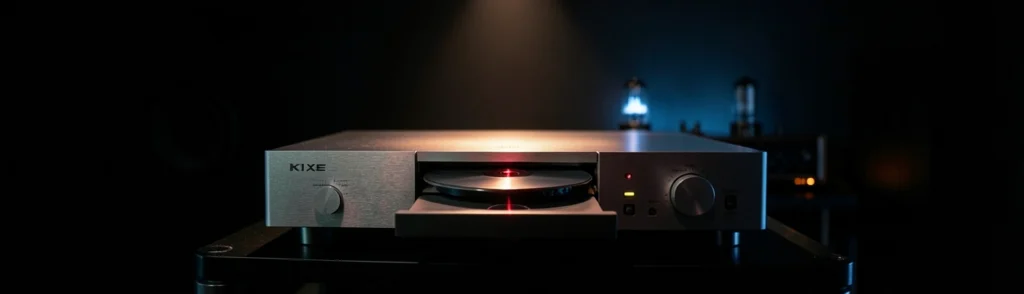

7 Controversial Blog Title Mistakes That Quietly Kill Your Traffic: Esoteric K1XE SACD Player Review
Intro: Why the Esoteric K1XE SACD player review matters
A flagship audio product can be technically extraordinary and still become a traffic failure if the article title misunderstands what readers actually want.
That is the central lesson behind an Esoteric K1XE SACD player review. The Grandioso K1XE is not an impulse-buy CD player. It is an ultra-premium component designed for listeners who already own substantial physical-media collections, use revealing hi-fi systems, and are willing to pay luxury-car money for incremental improvements in playback.
The supplied pricing places the K1XE at approximately US$45,000, with the optional Grandioso PS1XE external power supply adding around US$19,000. The player itself weighs roughly 34.3 kilograms, or 75 pounds. Those figures are not minor specifications. They define the product’s audience, its purpose, and the questions a serious review must answer.
A weak title might promise “the ultimate CD player” and attract the wrong audience. Another might repeat “SACD” and “hi-res audio” so aggressively that it sounds like an advertisement. A third might hide the price until the final paragraph, frustrating readers who could never consider the product.
The search intent behind a flagship SACD player review
People searching for this topic are not necessarily looking for a single thing. Their intent may include:
- Understanding SACD versus CD differences
- Learning what DSD64 playback actually means
- Finding a premium player for an existing SACD collection
- Comparing physical discs with streaming-based hi-res audio
- Evaluating whether the K1XE’s engineering justifies its cost
- Determining whether it also supports ordinary Red Book CDs
- Understanding the role of audiophile DAC power supplies
That makes the title unusually important. Searchers want technical context, but they also want judgment. They are asking, in effect: “What problem does this expensive device solve, and does that problem exist in my system?”
7 Title Mistakes That Can Quietly Kill Traffic
The seven most damaging title mistakes are not always obvious:
1. Being vague: “A New Era of Audio” tells readers almost nothing. It hides the product, format, and buying question.
2. Stuffing keywords: A title crammed with “SACD,” “DSD,” “hi-res,” “DAC,” and “audiophile” can look machine-written rather than useful.
3. Using bait-and-switch language: Calling the K1XE “affordable” or “for everyone” would create an immediate trust problem.
4. Ignoring the audience: A flagship player needs context about collectors, high-end systems, and luxury pricing.
5. Missing comparison intent: Readers often want SACD vs CD differences, not merely a list of features.
6. Making unsupported superlative claims: “The best-sounding player ever made” is difficult to prove and easy to distrust.
7. Burying practical buying information: Compatibility, system matching, external power, dimensions, and price should not be treated as footnotes.
The provocative truth is that a title can be technically accurate and still fail. It may contain the right keyword while answering the wrong question.
Background: Esoteric K1XE SACD player review essentials
What Is SACD?
SACD stands for Super Audio Compact Disc, an optical audio format introduced in 1999 through a joint development between Sony and Philips. It uses Direct Stream Digital rather than the Pulse Code Modulation system associated with standard CDs.
SACD is not simply “a better CD” in every practical situation. It is a different physical format with different encoding, mastering, playback, and hardware requirements. The disc must be read by a compatible player, and the recording itself must benefit from the format’s production chain.
A useful analogy is the difference between a high-resolution photograph and a printed postcard. The high-resolution file may contain more information, but the final result still depends on the camera, print process, display, and viewer. SACD can offer a technically broader format, but system quality and mastering remain decisive.
DSD64 playback explained for beginners
DSD64 uses a 1-bit signal sampled at 2.8224 MHz. It is commonly associated with a data rate of approximately 5.6 Mbps. A conventional CD uses 16-bit resolution at 44.1 kHz, with a commonly cited data rate of about 1.411 Mbps.
Those numbers sound dramatic, but they do not automatically translate into a universally superior listening experience. Data rate is not the same thing as musical quality. A poorly mastered SACD can be less engaging than a well-mastered CD.
DSD64 playback matters because it describes the digital format the player must decode. The K1XE is designed to handle SACD data and convert it into an analog signal through its internal digital-to-analog architecture. For beginners, the simplest explanation is this: CD and SACD store audio differently, and an SACD player needs the appropriate transport and conversion stages to read and reproduce the format.
SACD vs CD differences
The practical SACD vs CD differences involve more than sampling rate. They include:
- Different digital encoding methods
- Different playback hardware requirements
- Potentially different mastering choices
- Greater storage capacity for high-resolution or multichannel content
- A specialized collector ecosystem
Standard CDs remain important because they are widely available, inexpensive, and easy to play. SACDs are more specialized and often command higher prices, particularly for limited editions, classical recordings, jazz releases, and audiophile reissues.
The format comparison is therefore not a simple contest. CD is the universal workhorse. SACD is the enthusiast format. One is like a reliable family sedan; the other resembles a carefully engineered grand touring car built for a narrower audience.
Offline hi-res listening and physical music formats
Offline hi-res listening is gaining attention because it removes several layers of dependence. A listener does not need an active subscription, a stable network connection, or a platform that may change its catalog. The disc is owned, stored, and played locally.
That does not mean streaming is disappearing. Streaming is convenient and often offers enormous catalog depth. But convenience and ownership are different values. A person who wants instant access to millions of tracks will likely prefer streaming. A collector who wants a physical object, a specific mastering, and reliable access to a favorite album may prefer SACD or CD.
What the Esoteric Grandioso K1XE is designed to do
The Grandioso K1XE is positioned as a flagship Japanese SACD player. Its design focuses on reducing mechanical, electrical, and conversion compromises within a single high-end source component.
The player includes Esoteric’s VRDSATLAS transport mechanism, described as a rigid, heavy platform engineered for mechanical precision. The transport’s purpose is straightforward: read the disc as consistently as possible before the digital signal reaches the conversion stage.
It also includes the company’s Master Sound Discrete DAC G2, an internally developed digital-to-analog converter. The K1XE uses a fully dual-mono DAC configuration, with five independent linear power-supply systems. In theory, this architecture is intended to separate channels, reduce interference, and provide a more controlled analog output.
For readers, the key point is that the K1XE is not merely a disc spinner. It is a complete digital source built around transport stability, clocking, conversion, power delivery, and mechanical isolation.
Trend: Why offline hi-res listening is gaining attention
Physical music formats and the return of SACD collections
The renewed interest in physical formats is partly a reaction to digital abundance. When almost every song is available instantly, the act of selecting and playing a disc can become more intentional.
Reported U.S. CD revenue and volume growth during the first half of 2026 suggest that physical music remains commercially relevant, although growth in one period does not guarantee a permanent reversal of streaming’s dominance. SACD occupies a smaller niche, but its audience is unusually committed.
Collectors may purchase multiple editions of the same album because mastering, packaging, bonus material, or pressing quality differs. This behavior resembles photography enthusiasts buying lenses for specific conditions: the general-purpose option works, but the specialist tool offers a different experience and identity.
5 Benefits of Offline Hi-Res Listening
Disc ownership and dependable playback
A physical disc does not vanish because a licensing agreement changes. Once purchased, it remains playable as long as the hardware and disc are functional. That permanence is one reason offline hi-res listening appeals to collectors.
It also creates a predictable playback chain. The listener inserts the disc, selects the track, and avoids account restrictions, software updates, advertisements, or network interruptions.
DSD64 playback and high-resolution audio support
SACD’s DSD64 format gives compatible hardware access to a different form of high-resolution digital audio. The benefit is most meaningful when the recording, mastering, player, amplifier, and speakers work together.
It is better to view DSD64 as a format capability than as a guarantee of better sound. A larger pipe does not help if the source material is poor.
Focused listening without streaming distractions
Streaming interfaces encourage browsing, skipping, and constant discovery. Physical playback introduces friction, but that friction can be useful. A listener may be more likely to play an entire album rather than sample thirty seconds of dozens.
This is not nostalgia alone. It is a behavioral difference. The disc becomes the musical equivalent of closing unnecessary browser tabs before beginning concentrated work.
Long-term value for dedicated collectors
SACDs can hold value when they are scarce, well-mastered, or associated with respected labels and artists. However, buyers should not treat every disc as an investment. Most physical media is purchased for enjoyment, not guaranteed financial return.
The K1XE’s value follows the same principle. Its worth depends on how often it is used and whether its design addresses real limitations in the owner’s system.
Compatibility with standard CDs
Most SACD players are designed to read standard Red Book CDs as well, although product-specific confirmation should always be checked before purchase. This backward compatibility matters because many collectors own far more CDs than SACDs.
A flagship player that handles both formats can function as the central disc source for an entire collection. But buyers should verify supported disc layers, output formats, and regional or technical limitations with the manufacturer or dealer.
Insight: Esoteric K1XE SACD player review analysis
SACD vs CD differences in everyday listening
On paper, SACD offers a higher sampling rate and a substantially greater data rate than CD. In daily listening, however, the difference may be subtle, system-dependent, or dominated by mastering quality.
A revealing system can expose changes in spatial depth, treble texture, low-level detail, and image stability. Yet room acoustics, speaker placement, amplifier matching, and listener preference may matter more than the format label.
A fair review should therefore avoid declaring that every SACD is automatically superior. The more useful question is whether the K1XE creates a consistently convincing presentation across both SACD and CD playback.
Resolution, sampling rate, and data-rate comparison
CD audio uses 16-bit/44.1 kHz PCM. SACD uses 1-bit/2.8224 MHz DSD64. The formats approach digital audio from different technical directions.
PCM describes amplitude with multi-bit samples. DSD uses a high-frequency 1-bit stream. Neither explanation alone tells a listener how a product will sound. Implementation matters: clock stability, analog filtering, power regulation, output stages, and noise control all influence the final result.
That is why a serious Esoteric K1XE SACD player review should discuss architecture without pretending specifications replace listening evidence.
Audiophile DAC power supplies and noise control
Power supplies are often treated as background hardware, but in a high-end digital component they can influence noise, regulation, isolation, and circuit stability. The K1XE’s multiple linear power-supply systems are intended to support its dual-mono DAC configuration.
The optional Grandioso PS1XE external power supply takes that philosophy further. Its stated purpose is to reduce electrical interference, lower the noise floor, and move heat and high-voltage AC away from sensitive audio circuits.
The analogy is a clean laboratory bench. If delicate measurements are taken beside a vibrating machine, the instruments may still work, but the environment introduces unwanted disturbance. An external supply does not magically create musical detail; it aims to make the operating environment more controlled.
The role of the optional Grandioso PS1XE
The PS1XE is not a minor accessory. At approximately US$19,000, it represents a major additional commitment. Buyers should ask whether their system is sufficiently resolving, quiet, and well-matched to reveal any benefit.
External power supplies can be valuable in carefully optimized systems, but they also expose the danger of luxury-audio escalation. Once a buyer accepts a $45,000 player, a $19,000 power supply can begin to appear like a logical upgrade rather than a separate purchasing decision.
What the K1XE price and weight reveal about its audience
A 34.3-kilogram chassis and flagship-level pricing communicate that the K1XE is aimed at a narrow market. It is intended for serious collectors, high-net-worth enthusiasts, specialist listening rooms, and owners of systems where source components are treated as long-term investments.
The product is not trying to compete with an entry-level network streamer. Its competition is likely another premium disc transport, a high-end digital front end, or a buyer’s desire to preserve a reference physical-media setup.
Value, system matching, and luxury-audio trade-offs
Value is contextual. For one listener, the K1XE may be irrationally expensive. For another, it may be a rational centerpiece for a large SACD library and a reference-grade system.
The trade-offs are clear:
- Exceptional construction versus substantial cost
- Dedicated physical playback versus streaming convenience
- Engineering refinement versus diminishing audible returns
- Long-term ownership versus limited format flexibility
- System prestige versus practical utility
A review that hides these trade-offs is not informative. It is promotional.
Forecast: Where SACD players and physical audio may go next
Will SACD remain relevant for offline hi-res listening?
SACD is unlikely to become a mainstream replacement for streaming. Its future is more likely to resemble vinyl: a persistent enthusiast format with strong emotional and collecting value.
The market may become smaller but more premium. Labels could focus on carefully produced editions, deluxe packaging, archival recordings, and specialist genres. High-end manufacturers may continue serving buyers who want a complete reference disc system.
How DSD64 playback could shape future disc players
DSD64 playback may remain a foundational capability for premium SACD hardware, while manufacturers add support for other digital formats through USB, network, or external inputs. The disc player of the future may not be disc-only; it may combine SACD transport, CD playback, file decoding, and advanced clocking in a single chassis.
That evolution could make products more versatile, but it may also weaken the simplicity that attracts physical-media purists.
Growth of premium physical-format collections
Premium collections are likely to grow selectively rather than universally. Listeners may buy fewer discs but place greater value on mastering, packaging, provenance, and durability.
The strongest demand will probably come from collectors who see music as both an experience and an object. That is a narrower market, but narrow markets can sustain expensive products when customer loyalty is high.
What to watch in audiophile DAC power supplies
Future audiophile DAC power supplies will likely emphasize isolation, regulation, low-noise operation, modular architecture, and system integration. External supplies may become more common in flagship products, especially where manufacturers want to separate sensitive analog circuitry from heat-generating or high-current sections.
The critical question will remain measurable and audible value. Buyers should demand clear compatibility information and avoid assuming that more boxes automatically mean better sound.
Call to Action: Evaluate the K1XE for your listening system
Check SACD and CD compatibility before buying
Do not rely on general assumptions. Confirm whether the K1XE supports the exact SACD layers and CD formats in your collection. Verify outputs, dimensions, ventilation requirements, warranty coverage, and dealer support.
A $45,000 source component deserves more than a casual compatibility check.
Compare system needs, budget, and listening priorities
Ask yourself:
- Do you own enough SACDs to justify a flagship player?
- Is your amplifier and speaker system revealing enough to expose source differences?
- Do you prefer physical ownership to streaming convenience?
- Would the optional PS1XE fit your budget and rack space?
- Are you buying for sound quality, collecting, build quality, or prestige?
If the honest answer is that you mainly stream, a modern network source may be more practical. If you own a large SACD library and value offline hi-res listening, the K1XE becomes easier to justify.
Choose offline hi-res listening equipment based on evidence
Listen before buying when possible. Compare familiar recordings. Test both SACD and CD. Use matched volume levels. Ask whether the improvement remains obvious after the excitement of the demonstration fades.
The best purchase is not the product with the most impressive vocabulary. It is the component that solves a genuine problem in your listening system.
Conclusion: Is the Esoteric K1XE SACD player review persuasive?
Key findings on SACD vs CD differences and value
The Grandioso K1XE represents the extreme end of SACD playback. Its VRDSATLAS transport, Master Sound Discrete DAC G2, dual-mono architecture, multiple linear power supplies, and optional PS1XE address the concerns of listeners who want a highly engineered physical-media source.
The technical distinction between SACD and CD is real, particularly in encoding, sampling, and potential resolution. But format superiority is not automatic. Mastering, system quality, room conditions, and personal preference remain decisive.
The K1XE is persuasive as a statement product and specialized tool. It is less persuasive as a universal recommendation. Its price, weight, and narrow use case make that unavoidable.
Final checklist for choosing a flagship SACD player
Before purchasing, confirm:
– SACD and standard CD compatibility
– Supported disc layers and playback formats
– System matching with your DAC, amplifier, and speakers
– Rack strength, ventilation, and physical dimensions
– Dealer service and warranty support
– The value of the optional external power supply
– Whether you genuinely prefer offline hi-res listening
– Whether the expected improvement justifies the cost
The controversial lesson is simple: the K1XE may be an extraordinary player, but extraordinary engineering does not erase ordinary buying logic. A compelling Esoteric K1XE SACD player review should celebrate its ambition while making clear who should avoid it. That honesty is not bad for traffic. It is what earns trust, repeat readers, and the kind of search visibility that lasts.