
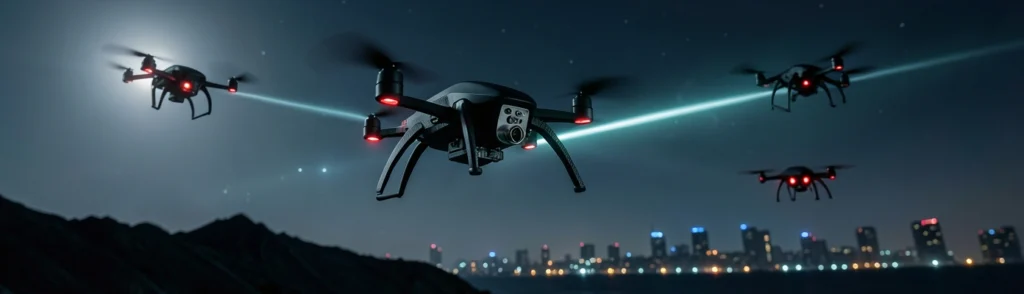

The Hidden Truth About AI Content Detectors Nobody Can Escape (laser power beaming drones security)
Intro: Why AI Content Detectors Feel Unavoidable
AI content detectors have a strange gravity. They show up everywhere—inside platforms, moderation pipelines, student-assessment tools, “brand safety” workflows, and increasingly in the background of government and enterprise compliance. The promise is seductive: identify synthetic writing, stop evasion, enforce trust. And because modern systems are fast, scalable, and—crucially—easy to route into decision-making, the detectors feel unavoidable.
But engineering reality is harsher. AI content detectors are not “truth machines.” They’re probabilistic pattern matchers wearing a suit that says science. If you treat them like a scoreboard rather than a calibration curve, you will eventually lose to either the attacker—or to your own false positives.
Now zoom out from text to the physical world, where the same failure mode repeats with different sensors: laser power beaming drones security and directed energy security. In both domains, detection is only one layer. You can have instrumentation, logging, and automated scoring—yet still miss what actually matters: intention, interference, system boundary conditions, and operational accountability.
Here’s the uncomfortable analogy:
1. An AI detector is like a smoke alarm without a fire department. It may scream, but it doesn’t extinguish anything unless the rest of the system is designed to respond correctly.
2. It’s like a metal detector at an airport—excellent at flagging certain objects, terrible at diagnosing why someone is carrying them and whether the threat is real.
3. And it’s like reading weather from a single sensor—useful, but insufficient for storm prediction without redundancy and modeling.
So why do these detectors feel inescapable? Because they’re cheap to deploy compared to the hard work of designing secure systems. If you can label a document “likely AI-generated” you can throttle distribution, lock accounts, or trigger review. That’s operationally convenient. In the same way, UAV remote charging via directed lasers sounds convenient: keep drones working, reduce logistics, and avoid landing. But convenience can hide systemic risk—especially around optical power infrastructure threats and aviation safety compliance.
This article doesn’t just critique AI detectors. It draws a parallel to how drone power systems can be “safe on paper” and unsafe in practice. The point is engineering-minded: detection doesn’t replace security architecture.
Background: Laser power beaming drones security basics
Laser power beaming drones security is the discipline of protecting systems that deliver energy from a ground or aerial transmitter to a UAV (receiver) using directed laser energy. The security goal is not only “can it deliver power?” but “can it be trusted under attack, interference, misalignment, and real-world operational constraints?”
In practice, that means directed energy security and UAV remote charging must be evaluated together—not as separate checkboxes.
Directed energy security concerns the safety, integrity, and control of systems that use focused energy beams—optical lasers being a prime example. For UAV remote charging, the beam must:
- Stay stable enough to recharge reliably
- Remain controllable enough to prevent harmful exposure
- Avoid becoming a new vector for spoofing, interference, or sabotage
A useful example is to think of it like electricity over a wire—except the “wire” is the atmosphere. In a wired system, you can isolate conductors. In laser beaming, you must isolate propagation paths.
Now consider UAV remote charging: instead of swapping batteries or landing for recovery, the UAV receives power in flight (or during stand-off operations). The receiver payload converts laser energy into usable power, enabling longer endurance and reducing downtime. That has strategic and operational value—but it also expands the attack surface from “battery handling” into “energy beam control.”
Aviation isn’t forgiving. Aviation safety compliance demands that any airborne-adjacent system is proven safe under normal operation and under plausible failures. With power beaming, “plausible failure” includes misalignment, partial beam interception, reflective surfaces, atmospheric effects, and emergency behavior.
Then add optical power infrastructure threats. These aren’t theoretical in the way content-detector vendors sometimes imply. If the system depends on an optical link, an adversary can attempt:
- Spoofing the receiver alignment or control handshake (e.g., manipulating targeting or sensor cues)
- Interfering with the optical path (e.g., fog/flare conditions, deliberate obscurants, or beam pollution)
- Redirecting effects so that the system delivers energy where it shouldn’t—creating safety hazards and mission risk
Engineering-minded takeaway: safety compliance is necessary but insufficient. You need threat modeling around optical paths, control loops, and the human/operational response.
A typical directed energy power-beaming system has three core parts:
- Power beaming transmitter: generates and steers the laser energy, often with tracking and control loops
- UAV receiver: captures incoming laser energy, usually via optical and photovoltaic or conversion stages
- Receiver payloads: includes power management, safety interlocks, and integration into the UAV’s energy system
Security is distributed across all three. If the transmitter steering is weak, the link becomes inconsistent. If receiver safety interlocks are shallow, misdirected energy becomes dangerous. If the payload firmware trusts inputs too much, an attacker can exploit the “brains” even if the beam hardware is intact.
Analogy: this is like a three-stage pipeline for content moderation—text ingestion, classifier inference, and policy enforcement. If any stage is soft, the whole pipeline breaks.
Traditional battery swapping is logistics-heavy but conceptually simple: controlled hardware exchange, bounded risk, and familiar compliance patterns. UAV remote charging trades logistics simplicity for systems complexity.
Key differences:
- Time: swaps take downtime; beaming aims to preserve mission continuity
- Risk distribution: instead of handling batteries, you manage beam safety and link reliability
- Operational dependencies: remote charging depends on alignment, weather, and path clearance
Think of it like shifting from “delivery by warehouse pickup” to “delivery by airborne refueling.” The promise is longer operation. The hazard is that you now need better control and better safety engineering.
Trend: Directed energy security and drone recharging momentum
The big shift in laser power beaming drones security is that autonomy changes what “security” even means. When the drone decides what to do next—how it aligns, when it requests power, how it handles degraded links—your security controls must account for automated behavior under stress.
The momentum comes from one idea: UAV remote charging over distance for extended endurance. If the drone can recharge without landing, you can support continuous coverage, reduce recovery logistics, and increase time on station for sensing or payload operations.
UAV remote charging over distance enables longer missions because the UAV isn’t constrained by the energy budget of a single battery pack. That matters for:
- Persistent surveillance
- Relay and communications support
- Payload-heavy operations where replacing batteries mid-mission is costly
Analogy: traditional battery-swaps are like driving long trips with fixed fuel stops every few hours. Power beaming is like upgrading to a system where a “fuel lane” can top you off while you keep moving—if the lane is secured.
But the same “lane” creates optical power infrastructure threats. The beam path becomes a strategic channel. If someone can disrupt it, the drone loses endurance. If someone can manipulate it, you risk safety failures or mission compromise.
Power beaming introduces new risk paths:
- The beam path can be targeted with interference
- The transmitter must be secured against spoofed targeting or malicious operating parameters
- Receiver tracking can be manipulated via reflective surfaces or sensor confusion
And this is where engineering discipline matters: you don’t just build a beam. You build an ecosystem around the beam—sensing, control, failsafes, and human governance.
1. Longer mission time without landing
Reduce operational downtime and preserve mission continuity.
2. Reduced contested-environment risk
Fewer recoveries and less exposure in areas where landing is dangerous.
3. More operational flexibility for payload operations
Keep the sensor or effects payload powered longer, improving outcomes.
4. Potential maintenance and logistics reductions
Lighter battery logistics and fewer landing cycles can reduce some wear-and-tear patterns.
5. Improved mission resilience vs battery swap dependency
If retrieval assets are delayed or constrained, beaming can maintain endurance—if the directed energy security controls are strong.
The provocative truth: these benefits are real only if the system’s security posture is mature. Otherwise, remote charging becomes a single point of failure—like trusting one AI detector to police an entire organization.
Insight: Hidden risks AI content detectors won’t tell you
AI content detectors focus on what was produced. Directed energy security must focus on how it’s controlled, what the system does under deviation, and who can influence it.
With power beaming, misuse doesn’t require a Hollywood “laser weapon” scenario. It can be simpler:
- Wrong targeting or steering behavior caused by flawed tracking logic
- Inadequate constraints on beam parameters
- Over-trust in control messages or sensor inputs
optical power infrastructure threats can show up as:
- Spoofing: falsifying alignment cues or compromising the control handshake so the system believes it’s safe
- Interference: degrading optical link quality to force unsafe fallback behavior
- Targeting abuse: attempting to redirect energy delivery so a non-authorized target receives power or safety is compromised
This mirrors a content-detector failure mode: if the classifier learns the wrong proxy, an attacker can game it. In laser beaming, proxies exist too—sensor readings, geometric estimates, and control flags.
Engineering-minded parallel: content detectors often assume the world follows the training distribution. Beam systems often assume the propagation environment behaves within expected tolerances. Attackers and real physics both love exceptions.
aviation safety compliance requires that systems be safe even when something goes wrong. But detection alone—like “we detected a mismatch” or “we flagged a likely anomaly”—doesn’t guarantee safety.
You need:
- Hard safety interlocks (not just warnings)
- Deterministic emergency behavior (what happens when tracking degrades?)
- Verification that compliance holds under adversarial-like conditions (not only normal tests)
Think of it like building a medical device with alerts but no shutoff mechanism. A warning can inform—but it can’t prevent harm if the system continues operating while you debate what the alert means.
AI content detectors usually measure statistical and stylistic patterns—probabilities that correlate with machine-generated text. A security system must measure different things:
- Link integrity (for power beaming: optical alignment and conversion stability)
- Control authenticity (who commanded what, and is it within safe bounds?)
- Environmental effects (is the beam path compromised by interference or atmospheric conditions?)
In both cases, you’re dealing with uncertainty. The difference is what you do with that uncertainty.
False confidence is deadly in safety systems. AI detectors can misclassify; beam systems can misbehave. If operators trust an anomaly score without enforcing strict control behavior, both systems can create outcomes that look “approved” while being wrong.
Example analogy:
- A false positive content-detector might lock a legitimate user.
- A false negative in directed energy security could keep a transmitter active while conditions are unsafe.
In engineering terms: probability without policy is a liability.
Forecast: Aviation safety compliance for 2027–2030
Between 2027 and 2030, expect directed energy security governance and operator accountability to harden. The field will move from experimental demonstrations to operational frameworks—because the cost of failure is too high.
Likely developments:
- directed energy security governance and operator accountability
Clearer responsibility chains: who validates transmitter configuration, who approves testing, who signs off on operational envelopes.
- laser safety zoning, testing, and reporting requirements
More formal requirements for safety zones around transmitters, structured testing protocols, and incident reporting rules.
What’s coming is not just regulation. It’s auditability: the ability to reconstruct what happened when something deviates—technical logs, safety interlock state, and control decisions.
As UAV remote charging scales, optical power infrastructure threats will become a standing concern rather than a niche risk. Forecast pressures include:
- Escalating sensitivity to interference and monitoring gaps
As missions become more continuous, even small interference windows can snowball into mission failures—or unsafe fallback behavior if the system isn’t designed for it.
- Stronger controls for remote charging test ranges
Expect more stringent access control, beam containment practices, and monitoring requirements for testing environments to prevent unauthorized observation or interference.
Future implication: the “attack surface” will shift from purely cyber to cyber-physical. That’s where engineers earn their keep—by designing defenses that survive both software adversaries and messy physics.
Call to Action: Secure your approach to laser power beaming drones
If you’re deploying or evaluating laser power beaming drones security, don’t start with marketing claims. Start with engineering proof and operational governance. Use this checklist to align teams:
- verify directed energy security protocols before deployment
- Confirm safety interlocks behave correctly under degraded alignment and environmental interference
- Require authenticated control paths and strict bounds checking for beam parameters
- Test emergency shutdown behavior in representative scenarios, not only in “happy path” demos
- document UAV remote charging procedures and safety margins
- Write down operating envelopes: distance, angle, atmospheric assumptions, and failure response thresholds
- Maintain procedure-level documentation for operators and automated controllers
- Track configuration versions so compliance evidence remains intact over system updates
This is the engineering way to avoid the “AI detector false confidence” trap: you don’t rely on a single signal. You build layered safety and layered accountability.
If you’re new to this space, your fastest path to competence is structured threat thinking—before hardware scales.
1. identify relevant aviation safety compliance requirements early
Treat compliance as part of the design cycle, not a final gate.
2. run a threat-model session for optical power infrastructure threats
Include stakeholders from controls, optics, safety engineering, and operations. Ask explicitly:
- What happens when tracking fails?
- How can the beam path be disrupted?
- What does the system do in ambiguous states?
Beginner mistake to avoid: focusing only on “can it recharge?” rather than “can it remain safe and trustworthy while it recharges?”
Conclusion: The real takeaway about AI detectors and drone security
AI content detectors feel unavoidable because they’re operationally convenient—and because many organizations confuse “detection” with “truth.” The hidden truth is that detectors are probabilistic, policy-dependent, and vulnerable to both error and adversarial adaptation.
The same lesson applies to laser power beaming drones security. Directed energy systems can deliver extraordinary capabilities—especially UAV remote charging for extended endurance—but only if directed energy security and aviation safety compliance are designed as an end-to-end architecture. And optical power infrastructure threats ensure that the beam is not just a power path; it’s a security and safety domain.
If you remember one engineering principle, make it this: a detector can raise an alarm; it can’t replace control.