
The Hidden Truth About AI for Small Businesses That Nobody Warns You About: underwater solar panels perovskite security reliability
Intro: Why small businesses should care about “reliability” first
Small businesses love AI for the same reason they love new tools: it promises speed, savings, and smarter decisions without the overhead of a larger team. But there’s a quiet, high-stakes difference between seeing AI work in a demo and keeping AI working when real life hits—weather, equipment downtime, patch cycles, staff turnover, shifting customer behavior, and increasingly sophisticated cyber threats.
This is the hidden truth: AI reliability isn’t a “nice-to-have.” It’s the operational foundation. And once you start thinking in reliability terms, you begin to notice a surprising parallel to a niche research topic that should matter to every small business operator: underwater solar panels perovskite security reliability. Perovskite photovoltaics underwater are being validated for depths where “just ship it” thinking fails. In the same way, AI deployments fail when the environment changes and the system was never engineered to survive that change.
Think of AI like a self-powered underwater device. If your “energy” supply is uncertain, and your “security” perimeter is assumed rather than designed, the system will eventually stop—not dramatically, but predictably. Reliability is engineering, not optimism.
Here are three analogies to make the point vivid:
– Underwater solar is to drones what AI uptime is to business workflows. If the power capture drops, the device sleeps or dies. If model performance drops (or access breaks), operations stall.
– Biofouling is like neglected data quality. Algae and organisms accumulate even when the hardware is “fine.” Likewise, data distribution shifts—customers change, fraud patterns evolve, policies update—until the model’s outputs degrade.
– Cybersecurity is the lock on the buoy. You can have a strong structure and great power, but if someone can tamper with the system, the mission ends. For AI, the “lock” is access control, logging, and incident response.
For small businesses, the reliability gap is wider than it should be because teams are smaller and roles are blended. You’re often expected to be the operator, analyst, and security reviewer—while also handling day-to-day growth. This article reframes AI reliability using the language of perovskite photovoltaics underwater, biofouling risk management, autonomous underwater sensors, and cybersecurity for marine devices—not because you run a marine lab, but because those fields have already learned (the hard way) what “works in principle” misses.
Background: What AI reliability really means for operations
AI reliability, in a business context, is the ability of your AI-enabled system to perform the right function consistently over time, under real operating conditions, with predictable failure modes and recovery options.
Reliability includes performance, but it’s broader than accuracy. A model can score well in testing and still be unreliable in production due to integration bugs, unstable dependencies, access drift, prompt changes, upstream data quality problems, and security incidents. When reliability is missing, you don’t just lose “insights”—you lose operational rhythm.
In marine research, the lesson is similar: a solar cell that works briefly in lab conditions may fail in the ocean due to depth-related performance changes, long-term degradation, and biological contamination. The environment is dynamic, and the “system” includes hardware, power management, and maintenance cycles.
For small business use, AI reliability means:
– Consistency: Outputs are stable enough for the workflow (not necessarily perfect, but dependable).
– Resilience: The system continues functioning when inputs change, components degrade, or partial failures occur.
– Observability: You can detect problems early (before customers feel it).
– Recoverability: You can roll back, reroute, or remediate quickly.
– Security integrity: The system behaves safely even under threat (tampering, data leakage, unauthorized actions).
If you want a practical definition: reliability is the gap between a model’s promise and the system’s lived behavior.
Perovskite technology is attractive because it can deliver high efficiency and flexible manufacturing pathways. But underwater use introduces risk factors that are not “optional.” Depth affects light capture; long-term exposure affects stability; and the marine environment invites biofouling risk management challenges.
Now map those to AI:
– Depth reality → changing operating conditions. In the ocean, depth changes the energy available. In business, seasonality, customer behavior, and internal processes change the “signal” your AI expects.
– Biofouling → gradual degradation. In the ocean, organisms accumulate. In AI, data quality decays and feedback loops distort inputs.
– Security perimeter → control over the system. In marine devices, threats include interference, spoofing, and unauthorized access. For AI, the threat model includes account compromise, prompt injection, data exfiltration, and model misuse.
In other words, underwater engineering teaches that reliability is not a single metric. It’s a stack of constraints and safeguards.
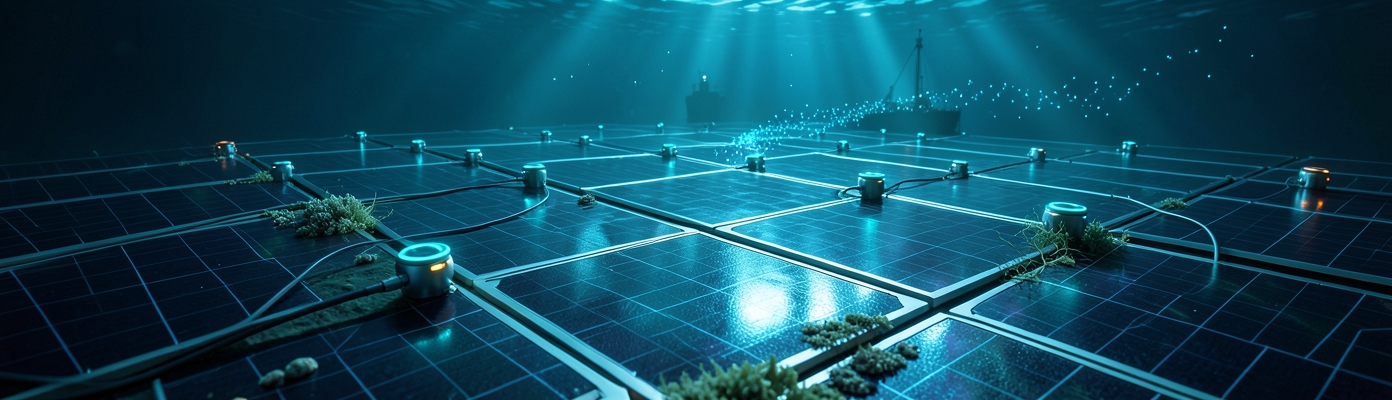
Underwater solar power is moving from concept to testing, and perovskite photovoltaics are a focal point because they can potentially provide better performance-per-area and adaptability for constrained form factors.
The key operational idea is straightforward: light availability decreases with depth, so energy capture must be validated where deployment actually occurs. Research on perovskite photovoltaics underwater is exploring submerged performance and the feasibility of charging or powering batteries for marine systems.
Key depth reality: testing up to ~10 meters beneath the waves
A major reason perovskite underwater work is compelling is that it targets more than “surface-adjacent” experiments. Testing has explored functionality down to roughly 10 meters beneath the waves, showing that energy capture can still support mission needs—at least for specific setups and times.
For small businesses, the takeaway is not the exact depth number. The takeaway is the mindset: validate performance where you will operate, not where it’s easiest to test.
Biofouling risk management as the “hidden variable”
Biofouling is the silent reliability killer in marine environments. Even if your solar module “works,” biological growth can reduce light transmission, affect thermal behavior, and complicate maintenance.
That maps directly to AI deployments:
– AI systems depend on ongoing input quality (data relevance, timeliness, correctness).
– Over time, data pipelines, labels, and upstream systems drift.
– Without biofouling risk management thinking, you treat degradation as a surprise rather than a planned hazard.
Future implication: as perovskite underwater systems move toward practical deployments, companies will demand not just “efficiency,” but maintenance predictability and operational reliability guarantees. AI will follow the same evolution: from model demos to reliability engineering and “uptime-first” governance.
Trend: The rise of marine-grade monitoring meets perovskite energy
A powerful trend is emerging: marine systems are becoming more autonomous, and autonomy depends on dependable power plus trustworthy control. This is where the energy side (perovskite underwater solar) meets the operations side (monitoring and sensors) and the safety side (cybersecurity).
Small businesses can learn from this trend because many AI deployments are already operating like marine systems: distributed inputs, limited resources, and continuous exposure to adversarial or unpredictable conditions.
Comparison: Autonomous underwater sensors vs. traditional power systems
Traditional systems often assume stable power availability. Autonomous underwater sensors can’t rely on that assumption. They must manage energy budgets, schedule transmissions, and operate in degraded or intermittent conditions.
This creates a reliability mindset:
1. Power is the limiting resource.
2. Work is planned around constraints.
3. Failure modes are expected and mitigated.
That is exactly the operational logic small businesses need for AI: if energy is analog to compute budget and data freshness, then reliability becomes a constraint-planning problem—not a best-effort feature.
When autonomous underwater sensors are powered by perovskite photovoltaics underwater, the system becomes self-sustaining—if energy capture remains sufficient and maintenance is feasible.
Translate to AI:
– Your “sensors” are data streams, customer signals, logs, and events.
– Your “power system” is compute, APIs, budgets, and integration stability.
– Your “uptime mission” is continuous decisioning and workflow execution.
If any component fails without detection, the system stops or produces stale outputs.
Insight from the trend: cybersecurity for marine devices is now part of uptime
As marine autonomy rises, reliability includes security. In the ocean, you can’t “just go reboot it” easily. Similarly, with AI, you often can’t quickly undo damage from a breach—or you can, but only after a costly incident.
Cybersecurity for marine devices and the reliability gap
A reliability gap appears when teams treat security as separate from operational performance. But in autonomous systems, security events often manifest as downtime, corrupted data, or manipulated decisions.
For AI deployments, cybersecurity for marine devices is an apt framing:
– Marine devices need trustworthy identities and controlled access.
– AI systems need cybersecurity for marine devices-style thinking: access control, secure configuration, audit trails, and recovery procedures.
Future forecast: expect reliability standards for AI to increasingly include security controls as first-class requirements—similar to how mission-critical marine systems incorporate authentication, integrity checks, and safe operation modes.
Insight: Hidden AI problems small businesses miss (and how to spot them)
Small businesses tend to focus on model performance and cost. Those matter. But the most common “hidden” failure modes are operational: maintenance, drift, and security gaps.
These issues are rarely visible until they cause disruption—by then, the repair cost is higher. Underwater power teaches that the cost of ignoring hidden variables is not theoretical; it’s how missions fail.
Underwater reliability is a maintenance story, not a marketing story. Even if a perovskite device is promising, it will still face environmental effects requiring servicing or proactive design changes.
For AI, maintenance beats promises means:
– Treat models as living components.
– Monitor inputs continuously.
– Plan for rollback, retraining, and access updates.
Biofouling risk management → “data drift” and “model decay”
Biofouling risk management doesn’t only address physical growth—it forces operators to think about how performance changes over time. In AI terms, the parallel is:
– Data drift: inputs change (new customer segments, altered behavior patterns, new formats).
– Model decay: the model’s assumptions become outdated.
To make the analogy concrete:
– Biofouling is like gradual loss of signal quality.
– Data drift is like the environment changing around your sensors.
– Model decay is like the system’s calibration becoming wrong.
A business that ignores this ends up firefighting—until the workflow becomes untrustworthy.
If you want AI that behaves like engineered infrastructure, build a checklist that merges reliability and security.
In marine devices, trust is established through controlled access and verified operations. For AI, your equivalent is cybersecurity for marine devices translated into:
– Identity and access management: Who can view, edit, approve, or deploy AI workflows?
– Least privilege: Reduce permissions for day-to-day operations.
– Audit logging: Every sensitive action leaves a trace.
– Secure integration boundaries: Protect data flowing between systems.
Reliability comes from controlling the pathways that can break the system—accidentally or maliciously.
Here are 5 reliability signals small businesses can audit quickly. These work like “instrumentation” on a deployed device—signals that tell you whether your system is healthy before it fails.
1. Incident logs: Are errors categorized, time-stamped, and tied to root causes?
2. Access roles: Are AI actions restricted by roles and reviewed periodically?
3. Model monitoring: Do you track drift indicators and performance proxies over time?
4. Rollback plan: Can you revert a model/pipeline change safely within a defined timeframe?
5. Test coverage: Do you have automated tests for critical flows (including edge cases and prompt/policy variations)?
Practical analogy: reliability signals are like the gauges on a boat’s dashboard. You don’t wait for engine failure to check oil pressure; you monitor early warnings.
Forecast: How to build dependable AI like energy systems
If AI is going to become truly dependable for small businesses, it will need the same evolution energy systems have undergone: constraint-based planning, maintenance schedules, and reliability engineering.
The underwater research mindset—validate performance at depth, address fouling, and integrate security into uptime—offers a blueprint for AI governance.
Perovskite underwater deployments force designers to think in terms of durability, exposure conditions, and degradation curves. That framing is directly useful for AI roadmaps.
In underwater contexts, “depth” is a stand-in for multiple constraints: energy attenuation, weather variability, biological activity, and maintenance accessibility.
In AI, your equivalent constraints are:
– Time: how long the system remains within acceptable performance bounds.
– Environment: changing business processes, customer behavior, and data schemas.
– Exposure: how frequently the system is stressed (campaign spikes, new integrations, high-volume periods).
Future implication: more small businesses will adopt “reliability budgeting,” where they allocate resources to monitoring, incident response, and maintenance just as seriously as they allocate resources to model development.
A useful roadmap treats AI like a deployed system with components:
– Sensors: data inputs and observation points (events, logs, customer interactions).
– Power: compute, APIs, budgets, model serving capacity, and dependency health.
– Cyber: access controls, integrity checks, and auditability.
This unified approach prevents the common pattern where teams build “great AI” but neglect the operational wiring around it.
Just as underwater systems need biofouling risk management, AI systems need data-quality operations:
1. Define data freshness requirements for each decision workflow.
2. Add validation rules for schema changes and unusual distributions.
3. Maintain a cadence for reviewing labels, feedback, and ground-truth accuracy.
4. Establish a drift response playbook (what changes trigger retraining vs. rollback).
Forecast: expect AI platforms and consultants to increasingly package these operations as standardized reliability modules—monitoring agents, drift dashboards, incident templates, and security guardrails—because the market will demand uptime.
Call to Action: Make your AI “uptime-first” this week
You don’t need a massive replatforming to start. You need a baseline that answers a simple question: If this AI breaks tomorrow, how will we know—and what will we do?
Start this week by converting reliability and security into concrete operational routines.
Use this 4-part baseline:
1. Threat model: Identify how the AI could be misused or compromised (access, data flows, prompts, integrations).
2. Monitoring: Enable logging and define early-warning signals for drift, latency, and failure spikes.
3. Incident response: Write a short runbook for AI-related incidents—who to call, how to contain, how to roll back.
4. Maintenance cadence: Set review dates for model/pipeline changes, access permissions, and data quality checks.
Analogy to close the loop: underwater teams don’t “hope the ocean stays calm.” They prepare checklists, maintenance schedules, and recovery procedures. Small businesses should treat AI the same way—engineering reliability, not trusting luck.
Conclusion: The hidden truth is that reliability is engineered
The hidden truth about AI for small businesses is that success is less about the model’s headline performance and more about whether the system survives time, change, and threat. Underwater solar panels using perovskite photovoltaics underwater show what it means to design for real conditions: depth constraints, biofouling risk management, and secure operation embedded into uptime.
If you remember one thing, make it this: reliability is engineered. The underwater lesson scales because your AI deployment is also an environment-dependent system—one that needs energy budgeting (compute and freshness), maintenance (data quality and drift response), and security (access control and cyber resilience).
Build your AI like you’d build a self-powered marine device: instrument it, protect it, plan for degradation, and make recovery routine. That’s how small businesses turn AI from a hopeful experiment into dependable infrastructure.