
The Hidden Truth About AI Job Displacement Nobody Wants to Admit
AI job displacement is the headline that writes itself: “robots will take our jobs,” “AI will replace workers,” “automation is accelerating.” But the version that most people discuss misses the mechanism that actually hurts—unverified automation deployed at speed. The uncomfortable truth is that the jobs going away aren’t always “hard AI roles.” They’re the intermediate roles that keep systems honest: simulation engineers who catch corner cases, QA operators who validate edge behavior, autonomy testers who demand evidence, and operators who notice when reality doesn’t match the model.
In this story, the villain isn’t intelligence. It’s optimism without a deterministic sim-to-real loop—the feedback system that connects an autonomy policy to reality with measurements you can replay, audit, and verify.
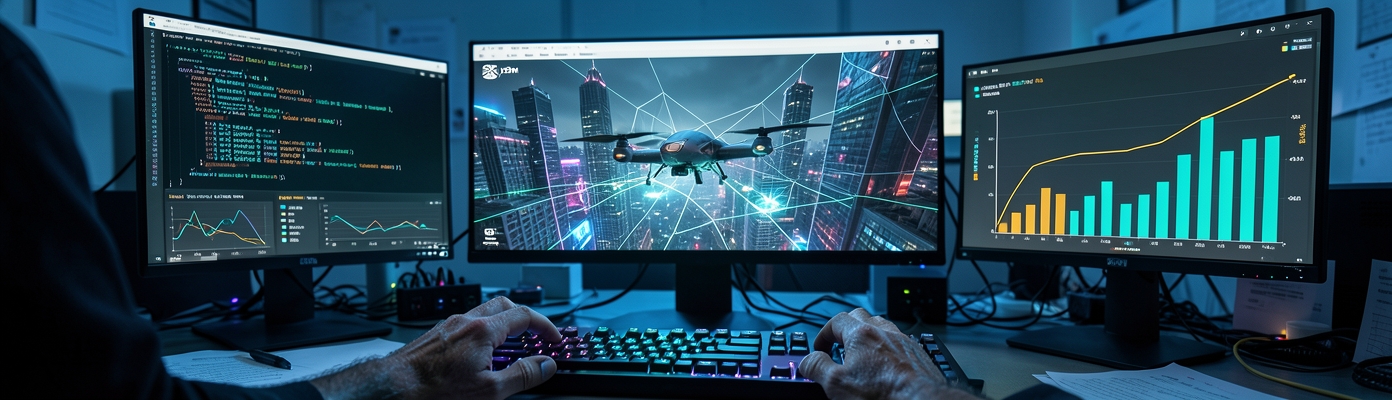
A concrete example of what “verification-first” looks like comes from the SkySim browser-based drone simulator deterministic sim-to-real loop approach: a workflow designed to make testing cheaper, faster to iterate, and—most importantly—honest about what has and hasn’t been proven.
SkySim browser-based drone simulator deterministic sim-to-real loop
A deterministic sim-to-real loop is a closed pipeline where simulated sensor inputs, vehicle dynamics, and control outputs behave in a repeatable way—so the same “run” can be reconstructed later, analyzed deeply, and compared against real-world behavior.
Determinism matters because autonomy failures are rarely dramatic in the moment. They’re subtle: a controller that oscillates slightly differently, a perception threshold that shifts under mild noise, or a physics assumption that only breaks when battery voltage sag changes actuator authority. If you can’t replay what happened, you end up chasing ghosts.
Think of it like flight-testing a prototype airplane—but instead of recording black-box data, you take snapshots from a video call. You might see what went wrong, but you can’t rewind time to reproduce the exact chain of causes. A deterministic replay pipeline is the difference between “I think something changed” and “here’s the exact input sequence and state trajectory that caused the failure.”
In SkySim’s framing, the loop doesn’t end at training success in the simulator. It continues with:
– Running autonomy code with simulated sensors that match what the code expects.
– Recording trajectories and sensor signals with deterministic replay.
– Generating data that can be labelled and reused.
– Validating performance under a real runtime check.
– Iterating when reality disagrees with the assumptions.
Deterministic sim-to-real loop behavior is what allows engineering teams to treat simulation as an evidence generator rather than a guess factory.
The operational challenge is not “can we generate data?” It’s “can we generate data we can trust and reuse.”
SkySim emphasizes deterministic replay and labelled dataset generation so that every recorded run becomes a stable artifact:
– You can replay the same scenario and controller behavior.
– You can generate datasets from those runs with consistent semantics.
– You can train, debug, and benchmark on a known baseline.
In practice, this turns data into an engineering asset. Like a version-controlled experiment notebook, each dataset represents a reproducible state of the world. Without determinism, your datasets become interpretations of reality—useful sometimes, but unreliable when failure analysis matters.
Another analogy: imagine building a compiler optimization pass. If the compiler output changes unpredictably for the same input, you don’t “learn faster”—you ship inconsistent binaries. Deterministic replay is what keeps your “compiler of reality” from changing its mind between runs.
And a third example: in robotics, a navigation failure can depend on tiny timing differences. If you can’t replay the same timing and sensor sequence, you can’t isolate whether the bug is in perception, planning, or actuation. Deterministic replay collapses the search space.
The result is a foundation for evidence-driven autonomy development: you stop arguing about what might be happening and start proving what happened.
Honest sim-to-real validation means you explicitly test—and record—the transfer boundaries of your autonomy stack. You measure what improves in simulation, then confirm whether it survives in runtime. This is where engineering teams protect themselves from “looks good on paper” failures.
Here are five benefits that matter to real autonomy programs:
1. You prevent silent failures
When simulation and reality drift, the system may still produce “acceptable” outputs until the drift grows into a catastrophe. Honest validation catches this before deployment.
2. You reduce debugging time
Deterministic replay and datasets shorten the loop between failure and root cause. Instead of re-creating conditions manually, you reconstruct them.
3. You make improvements measurable
Without validation, improvements are subjective. With honest sim-to-real transfer validation, every patch can be judged by runtime-validated metrics.
4. You align teams around evidence
Simulation, ML training, and control engineering often operate in different languages. The validation pipeline becomes the shared scoreboard.
5. You enable safer scaling
Teams that validate honestly can scale iterations—new policies, new sensors, new controllers—without multiplying risk.
These benefits directly connect to job displacement fears. When companies deploy autonomy without validation discipline, they can reduce headcount for “slow” testers. But that “efficiency” is often borrowed from future incident costs—operationally expensive, legally risky, and technically avoidable.
To achieve honest validation, you need a methodology that distinguishes between what the simulator measures and what runtime confirms.
SkySim’s philosophy maps to an honest sim-to-real transfer validation methodology that typically includes:
– Defining success metrics separately for simulation and for real runtime.
– Using deterministic replay to isolate where mismatch occurs.
– Applying labelled dataset generation so perception and control changes are evaluated consistently.
– Running comparisons that explicitly track what transfers and what doesn’t.
This methodology is not glamorous. It’s the unglamorous work that keeps autonomy from becoming a lottery.
A key mindset shift is to treat simulation as a test instrument rather than a truth oracle. The simulator can be excellent—if you validate its boundaries.
Background: why AI pilots replace “easy” automation jobs
The reason “AI pilots” replace certain automation jobs isn’t just capability—it’s deployment mechanics. When autonomy is packaged as software that can be iterated quickly, organizations choose it because it’s:
– Faster than manual operators to react to routine conditions
– Cheaper than human labor at scale
– Scalable across fleets and environments
If you can run hundreds of scenarios in a test rig, it looks like a rational decision to replace humans who mostly perform repetitive checking. But that logic assumes the system behaves reliably in the real world.
In reality, automation speed becomes a multiplier for mistakes. When you deploy quickly without validation, you don’t just automate tasks—you automate errors.
Simulation often gives you curves that look smooth. Reality gives you jagged edges. The silent failure risk is that the system may fail only under conditions you didn’t model—or only after time-dependent drift appears.
This is where deterministic engineering meets real-world operations:
– Battery effects change actuator authority.
– Wind and turbulence alter dynamics.
– Sensor noise isn’t just “Gaussian”—it has structure.
– Timing jitter alters control loop interactions.
Without a robust deterministic sim-to-real loop, the system becomes like a navigation app that updates based on GPS—but your city’s GPS broadcast changes sometimes. The map looks fine, until you’re lost. And since it “usually works,” you don’t know when you crossed the line.
SkySim’s broader goal is to make this cross-line visible earlier: test until you can defend the transfer.
SkySim is a drone autonomy testing effort built to make simulation accessible and evidence-oriented—especially via a browser-first approach.
When your goal is to validate autonomy policies quickly, friction is enemy number one. Installing heavy stacks, configuring GPU pipelines, or waiting on game engines turns testing into a bottleneck. SkySim aims to reduce that friction so the team can run more experiments and generate better datasets.
The important part is not that it’s “cool web tech.” It’s that it supports deterministic testing behavior and a pipeline for replay and labelled generation.
SkySim’s core physics is described as WebAssembly DroneCore C++20 physics—a real dynamics computation layer packaged to run reliably in a browser.
This matters for testing in two ways:
1. Portability and repeatability
Running physics in WebAssembly helps standardize behavior across environments—crucial when you want reproducible sim-to-real outcomes.
2. A foundation for deterministic pipelines
The physics core becomes a stable component you can integrate into a replay pipeline, record runs, and generate datasets.
Engineering takeaway: if you want an autonomy validation system to be defensible, the simulator must be stable enough to function like a measurement instrument, not a shifting sandbox.
Trend: from Gymnasium RL to browser-first drone testing
Reinforcement learning testing has popularized a common pattern: define environments, run agents, record results, and iterate.
SkySim connects to that ecosystem through Gymnasium SkySimEnv HoverTask WaypointTask tasks—framework-style scenario definitions that map to common autonomy training and evaluation patterns.
In that world, Gymnasium environments are more than demos; they’re structured interfaces to state, actions, observations, and rewards.
The Gymnasium integration enables common workflow accelerators:
– Gymnasium wrappers to reshape observations or actions
– Vectorization to run many episodes in parallel
– Recording agents to save trajectories and evaluate behaviors consistently
A useful engineering analogy: vectorization is like having multiple wind tunnels running simultaneously. Faster iteration is good—but only if each tunnel is calibrated and the measurements are replayable. Otherwise, speed turns into noise.
The deterministic replay idea complements vectorization: you can parallelize exploration but still preserve the ability to reconstruct specific failures.
The bigger trend is shifting autonomy testing toward the web—not because drones are “web things,” but because teams need low-friction testing that doesn’t require every developer to install a full robotics stack.
SkySim’s browser approach uses a combination of Emscripten + Three.js browser physics core to run the physics in WebAssembly while presenting visualization in a browser environment.
This architecture supports a key engineering strategy: decouple the compute-heavy deterministic physics layer from the front-end visualization layer. That separation makes it easier to verify and reproduce the core dynamics behavior without being trapped by GUI variability.
Engineering takeaway: browser-first testing can reduce iteration time, but determinism and validation discipline keep it from becoming “faster wrong.”
Insight: the real threat isn’t AI jobs—it’s unverified sims
AI displacement narratives often focus on who gets replaced. But the more immediate threat is what gets deployed: autonomy systems trained and validated against unverified simulations.
Unverified sim-to-real behavior creates a false confidence cycle. Teams believe performance will transfer because it improved in the sim. When reality contradicts the model, the failure is costly—and sometimes catastrophic. That’s why honesty becomes a competitive advantage.
Deterministic replay is the core that turns postmortem into engineering. With deterministic replay:
– A failure can be reproduced exactly.
– Hypotheses can be tested with controlled changes.
– Root cause becomes measurable rather than anecdotal.
This is like having a crime scene where you can rewind the footage to the second level and examine exactly which action caused the anomaly. You’re not guessing—you’re re-running the same conditions.
Once you can replay runs, you can also generate datasets with consistent labels and meanings. That’s what deterministic replay and labelled dataset generation accomplishes.
Future-facing implications:
– Companies will increasingly treat datasets as “test artifacts,” not training fuel.
– Audit trails and replayable experiments will become a hiring and compliance differentiator.
– Model evaluation will shift from “accuracy on a benchmark” to “accuracy under reproducible conditions.”
Determinism becomes not just a technical feature, but part of organizational governance.
A good comparison highlights the difference between simulation-only and runtime-validated claims.
– Sim-only metrics vs runtime-validated metrics
– Sim-only metrics answer: “Did the policy learn to score in the simulator?”
– Runtime-validated metrics answer: “Does the policy perform when the real system introduces the differences the simulator didn’t perfectly model?”
This is the moment where honesty wins. If your real-world test shows only partial transfer, you don’t hide it—you use it to improve your validation methodology.
When you combine WebAssembly DroneCore C++20 physics with a replay pipeline and environment tasks like Gymnasium SkySimEnv tasks to datasets and policies, you get a structure that can scale.
The pipeline becomes:
1. Run tasks (HoverTask, WaypointTask).
2. Record deterministic trajectories and sensor signals.
3. Generate labelled datasets.
4. Re-train or re-tune policies.
5. Validate against runtime reality.
6. Document boundaries and failures.
A future forecast is unavoidable: autonomy systems will increasingly demand evidence packages—replay logs, labelled datasets, and documented sim-to-real transfer outcomes—because the market will penalize “demo-only” systems harder than it penalizes “slower but verified” systems.
Forecast: safer autonomy pipelines will reshape hiring
The job displacement narrative will evolve. The hiring trend won’t just be “fewer engineers.” It will be different engineering roles: more people who can build validation harnesses, manage determinism, interpret transfer gaps, and produce auditable evidence.
Organizations are realizing that ML demos don’t prevent incidents. Auditable workflows do.
The shift from ML demos to auditable validation workflows will likely include:
– Deterministic replay requirements for regression testing
– Labelled dataset generation tied to specific scenario IDs
– Explicit “transfer boundary” reporting
– Runtime checks that mirror deployment conditions
In other words: engineers who can build systems that prove behavior will be valued, not engineers who only build systems that look impressive.
SkySim’s roadmap direction points toward a future where platforms move from “Python evaluation” toward verified deployment.
That includes:
– stronger integration of deterministic replay and labelled dataset generation
– clearer honest sim-to-real transfer validation methodology
– tooling that bridges simulation artifacts to runtime evidence
Over time, this will reshape how teams test autonomy: less ad-hoc manual testing, more automated replay-and-compare systems.
There’s one warning that most deployment marketing avoids: the honest statement that no verified sim-to-real transfer result exists yet.
This warning fits exactly where the market is headed. It’s not an embarrassment—it’s a boundary. It means the team is building the right apparatus before claiming guarantees.
Deterministic replay and labelled dataset generation become the mechanism that gradually replaces unknowns with verified claims.
Future implication: companies that publish what they cannot verify will earn trust faster than companies that publish only what works.
Call to Action: build your own SkySim-style validation harness
You don’t need to adopt SkySim to adopt its engineering discipline. You need a harness that makes simulation behavior replayable and transfer truth measurable.
Here’s a step-by-step checklist to create your own deterministic sim-to-real loop:
1. Define the scenario interface
– Tasks, initial conditions, sensor schemas, actuator models.
2. Implement determinism at every boundary
– Seed everything.
– Ensure physics and control loops replay identically.
– Lockstep protocols help when multiple components interact.
3. Record the run as an artifact
– Inputs (scenario parameters, seeds).
– State trajectories (as available).
– Sensor outputs and control signals.
4. Verify replay before training
– If the same run can’t be replayed bit-for-bit, your training results will be shaky.
5. Build the labelled dataset pipeline
– Decide labels (e.g., collision events, tracking error bands, waypoint success).
– Ensure labels map cleanly to replayed run identifiers.
6. Only then start sim training and policy iteration
– Use the deterministic runs as stable ground truth.
This is where “speed” becomes safe—because determinism makes optimization accountable.
A hard rule: deterministic replay before training and deployment.
If you only apply replay after you have a model, you’ll spend more time debugging inconsistent datasets than improving autonomy.
Engineering takeaway: determinism is a prerequisite, not a post-hoc tool.
To make validation honest, add runtime checks and treat them as part of the same loop.
1. Generate labelled dataset generation outputs
– Tie each label to a replayable run.
2. Run runtime-validated checks
– Compare sim-only metrics against runtime outcomes.
3. Report transfer gaps
– Document what transfers, what doesn’t, and why you believe the mismatch exists.
4. Use replay to debug mismatches
– When runtime diverges, replay to isolate where.
This is how you build “audit-ready” autonomy rather than “hope-based” autonomy.
Conclusion: admit the hidden truth and validate reality
AI job displacement will continue to be debated in slogans. But the hidden truth is more engineering than political: jobs disappear fastest when automation is deployed without proof, and proof is hardest when simulation can’t be replayed and validated honestly.
SkySim’s approach—centered on a SkySim browser-based drone simulator deterministic sim-to-real loop, backed by deterministic replay and labelled dataset generation, and guided by an honest sim-to-real transfer validation methodology—shows a path where autonomy development becomes evidence-driven instead of demo-driven.
Predictions are cheap. Verification is expensive. But reproducibility and verification compound—they reduce debugging time, improve iteration quality, and prevent silent failures.
If you want autonomy pipelines that are safer—and if you want teams that stay relevant in the hiring shift—build the harness first. Then let your policies earn their claims in runtime reality.