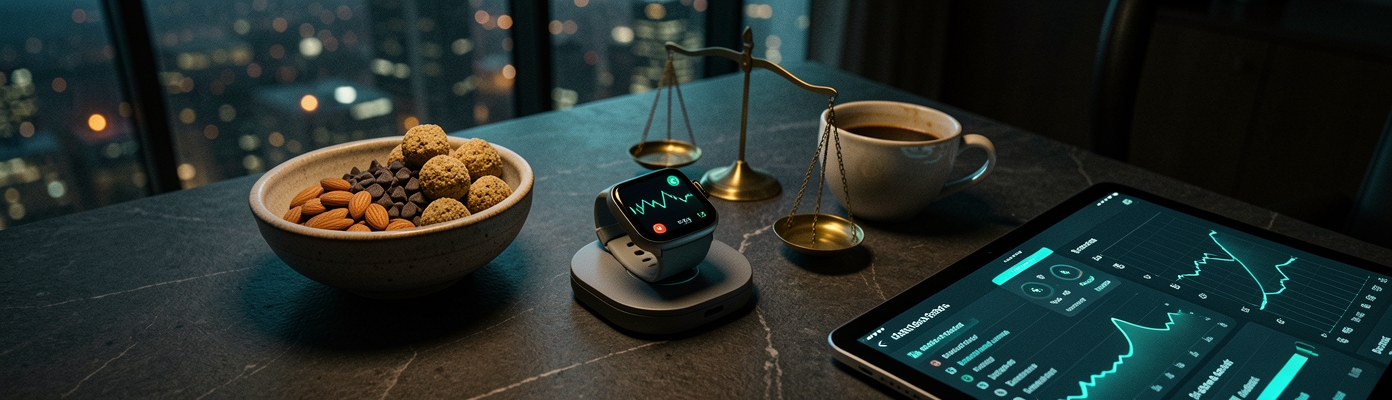

How Busy Professionals Use Sugar-Free Snacks to Stop Cravings Fast
For busy professionals, cravings aren’t just a “willpower” problem—they’re often a timing problem, a stress problem, and sometimes a metabolic feedback problem. A growing number of people are pairing rapid snack substitutions (like sugar-free options) with wearable-derived context—especially around insulin resistance. For some, that context is arriving via consumer devices, such as Pixel Watch 5 insulin resistance trends, packaged as month-to-month “nudges” rather than constant readouts.
This article explores how sugar-free snacks fit into a practical craving-stopping routine, why insulin resistance trends matter for cravings, and—just as importantly—how to track health metrics without slipping into anxiety. We’ll also touch related themes like Health Guardian, CGM vs optical sensors, the wearable health obsession risk, and the digital health psychological impact that can come with checking graphs too often.
Along the way, you’ll get a straightforward plan designed for packed calendars: act daily, review weekly, and keep the focus on routines—not readings.
Pixel Watch 5 insulin resistance trends: why it matters to cravings
Cravings tend to spike when your body is under strain—late meetings, missed meals, poor sleep, high stress, and yes, frequent sugar exposure. Insulin resistance (in simplified terms) is when your body becomes less responsive to insulin, so your metabolic system may swing more strongly after meals—especially meals that are high in rapidly absorbed carbs.
That’s where Pixel Watch 5 insulin resistance trends can feel relevant to craving control. The key word is trends. A trend is not a real-time diagnosis; it’s a pattern—something you can use to adjust habits over time.
Think of insulin resistance like a thermostat in a smart home:
– If the thermostat becomes sluggish, the room temperature overshoots before it stabilizes.
– Likewise, when metabolic response is blunted, you may experience bigger swings in hunger and energy after certain foods.
– A trend metric can help you spot those overshoots before they become habitual.
Now consider another analogy: cravings can behave like a “notification flood” on your phone. If your system is already stressed, every notification (a snack ad, a meeting snack, a low-energy dip) feels louder. Sugar-free snacks work as a kind of “quiet mode,” reducing the immediate sugar signal while you reset your routine.
Finally, a third example: imagine you’re driving and only checking the speedometer every minute. You won’t know every bump in the road, but you can still learn whether you’re generally speeding or not. Pixel Watch 5 insulin resistance trends are meant to be that “every so often” view—focused on monthly shifts rather than moment-by-moment spikes.
For busy professionals, that framing matters because it encourages action without compulsive monitoring.
Background: insulin resistance, sugar cravings, and snack habits
Insulin resistance is when your cells don’t respond to insulin as effectively as they used to. Insulin is a hormone that helps move glucose (sugar) from the bloodstream into cells for energy or storage.
When cells resist insulin’s signal, the body may compensate by producing more insulin. Over time, this metabolic strain can correlate with increased appetite, energy swings, and a higher likelihood of cravings—particularly for quick energy sources.
In the context of consumer wearables, it’s important to remember that insulin resistance is complex and not something most devices can measure directly in the lab sense. Still, some devices estimate metabolic patterns using sensor data and algorithms—giving users a practical proxy.
Health Guardian is the kind of suite where a passive wrist approach can be positioned as a “gentle reminder” system rather than a clinical test. The idea is typically:
– Use sensors on the wrist to infer metabolic patterns,
– focus on monthly shifts,
– and reserve formal lab work for clinicians.
This is a meaningful distinction. Lab tests are like taking a fingerprint from a crime scene; wearables are more like using a weather app to predict storms. Both can be useful, but they operate with different certainty levels.
If you treat wearable outputs as lab-grade truth, you risk misinterpretation. If you treat wearable outputs as routine guidance—one signal among many—it can support healthier choices.
Sugar-free snacks can help primarily because they reduce the “fast sugar” effect that some people experience as a craving amplifier. For many professionals, cravings come after:
– skipping meals,
– relying on coffee + a quick sugary bite,
– or snacking during high cognitive load.
Sugar-free snacks don’t automatically “solve” insulin resistance. But they can help break a common loop: sugar-in → spike/feedback hunger → more sugar seeking.
Within the logic of consumer Health Guardian-style metrics, the goal isn’t to chase every fluctuation. It’s to improve habits—like how you snack during long workdays—so your longer-term patterns shift. If someone uses Pixel Watch 5 insulin resistance trends as context, sugar-free options can become part of a low-friction plan:
– Replace one common sugar snack with a sugar-free alternative,
– Pair it with protein/fiber when possible,
– Use it when cravings hit, especially after late lunches or stressful mornings.
However, there’s a cautionary lens here. The digital health psychological impact of tracking can be subtle:
– You may start to associate snack choices with constant self-evaluation.
– You may interpret normal appetite as “failure.”
– You may begin checking metrics for reassurance.
This is where discipline can tilt into obsession—especially if a person has a history of anxiety around health behaviors.
A balanced approach keeps wearable metrics secondary to daily living. Think of the watch as a coach, not a judge.
Trend: Pixel Watch 5 insulin resistance trends vs CGM-style data
Some people hear “insulin resistance trends” and immediately compare it to CGM (continuous glucose monitoring). But the experience is different.
Pixel Watch 5 insulin resistance trends are typically described as trend-level insights from passive sensors, while CGM-style approaches are built around more direct glucose sensing—often with different accuracy, different invasiveness, and different behavioral consequences.
Here’s a plain-English comparison:
– CGM: Often measures glucose-related signals more directly (frequently via interstitial readings). It’s like getting a live dashboard from a sensor that’s closer to the target.
– Optical/passive wrist sensing: Uses light and motion-related cues (plus algorithms) to estimate metabolic patterns. It’s more like using indirect instruments—like reading weather from cloud behavior rather than a barometer at the epicenter.
For non-experts, the takeaway is not “one is better,” but “they answer different questions”:
– CGM-style systems may be better for minute-to-minute learning.
– Wearable trends may be better for monthly habit feedback—less granular, potentially less anxiety-triggering if used carefully.
The wearable health obsession risk often shows up as behavior patterns like:
– Checking metrics repeatedly after eating small portions,
– Getting “stuck” trying to achieve a perfect number,
– Changing meals every hour based on trend noise.
In cravings contexts, this matters because cravings are often emotional and situational. If monitoring becomes a ritual, it can backfire—turning a craving-stopper plan into a new source of stress.
Digital health psychological impact research and clinical observation frequently point to the same mechanism: when people treat metrics as moral scoring, anxiety rises, and decision-making narrows.
Discipline looks like:
– Using data to decide your snack choices for the day,
– Reviewing trends weekly,
– Adjusting gradually and realistically.
Obsession looks like:
– Treating each reading as an emergency,
– Repeating checks to “prove” you’re okay,
– Feeling guilty or panicked when you can’t control appetite perfectly.
Use this analogy: discipline is like doing grocery planning once a week; obsession is like re-checking the pantry every five minutes to prevent “runout.” Both involve organization, but only one is sustainable.
If you want to use Pixel Watch 5 insulin resistance trends responsibly, keep the “check rhythm” long enough to support learning without panic.
Insight: turning trends into routines (without anxiety)
The best use of any metabolic trend is converting it into an easy routine—one that fits a real workday. The target is habit change, not metric perfection.
A helpful framing: trends are directional. Routines are actionable.
If your device provides Pixel Watch 5 insulin resistance trends, think of them as monthly feedback on how your patterns are evolving. That means you should expect:
– variability day-to-day,
– but clearer direction over weeks.
Monthly shifts matter because cravings often follow repeated behaviors:
– How often you skip breakfast,
– How late your last meal runs,
– What your go-to snack is during afternoon meetings,
– How stress affects your appetite.
A cautionary note: don’t interpret a single week’s change as a verdict. Interpreting noise as signal is a common path to anxiety and overchecking.
Within Health Guardian, the design goal is typically to make alerts feel like gentle nudges. Still, your personal goal should be even gentler: use the trend as a planning tool for next week’s snack strategy, not a reason to spiral today.
Because CGM vs optical sensors differ in granularity and certainty, the best practice is to treat wearable trends as:
– “One input,” not “the truth.”
– A guide for experiments (like swapping sugar-free snacks into your routine).
– A reminder to focus on fundamentals: sleep, meal timing, and overall diet quality.
Here’s a five-step approach designed to reduce cravings without turning tracking into stress:
1. Choose one craving trigger window
For example: “2–4 pm meetings” or “mid-afternoon slump.”
2. Swap one snack category (not your whole diet)
Replace the usual sugary snack with a sugar-free option that includes satiety allies like protein or fiber.
3. Anchor to timing, not mood
Eat the snack when cravings usually hit, not when you feel desperate.
4. Log minimally, review weekly
Use a simple note: “Did I follow the plan?” Don’t obsess over numbers.
5. Adjust gradually based on monthly trend direction
If Pixel Watch 5 insulin resistance trends suggest persistent elevation, refine the routine (portion size, snack type, meal timing) rather than adding more tracking.
Notice the built-in defense against overchecking: “review weekly” and “adjust monthly.” That schedule directly reduces the anxiety loop.
This is also consistent with how Health Guardian-style metrics are framed—gentle nudge, habit support, not constant surveillance.
Forecast: what to expect from digital health metrics next
Digital health metrics are moving fast, but the most important evolution may not be sensors—it may be behavior design. In other words: how products prevent the wearable health obsession risk while still delivering useful guidance.
Expect more “hybrid” approaches:
– improved estimation algorithms for optical sensors,
– better integration with meal timing and activity,
– and clearer context around uncertainty.
The likely direction:
– CGM-style systems remain valuable for people who want real-time glucose learning,
– while passive/wearable trends become more common for habit coaching.
That said, consumer systems still need better guardrails so users don’t treat estimates like clinical truth.
The future forecast should include explicit user-protection features such as:
– limits on alert frequency,
– “trend-only” dashboards by default,
– and education that clarifies what the metric can and can’t measure.
Your best defense as a user will remain simple: build a review rhythm (weekly/monthly), not a check-every-30-minutes rhythm.
If Health Guardian alerts or trend nudges are part of your workflow, adopt best practices like:
– Set one “alert response” time per day (e.g., after lunch).
– Avoid responding immediately by re-checking repeatedly.
– Use alerts to adjust behavior next meal, not to judge the last one.
– If you feel anxious, pause tracking for a week and focus on snack routine adherence.
These practices reduce digital health psychological impact and keep the device helpful rather than intrusive.
Call to Action: set a craving-stopping plan using sugar-free snacks
Let’s turn the concepts into a practical plan you can start today. The goal: stop cravings fast, stay consistent, and use Pixel Watch 5 insulin resistance trends as a background guide—not a constant scorecard.
Use this routine template:
– Daily (act):
Keep 1–2 sugar-free snacks ready for your typical craving window. Pair with protein/fiber when possible.
– Weekly (check):
Review your adherence: Did you follow the plan most days? Did late meals or stress disrupt it?
– Monthly (trend context):
Look at Pixel Watch 5 insulin resistance trends directionally. If it worsened, adjust snack timing or composition, not your identity.
In the Health Guardian mindset, the device supports behavior change through gentle feedback. Keep your actions aligned with the feedback schedule:
– Daily snack decisions,
– Weekly reflection,
– Monthly refinements.
Finally, set a personal rule to protect your mental bandwidth:
– If you catch yourself repeatedly checking after eating, stop and go back to the routine plan.
– If cravings persist despite consistent routine, consider discussing metabolic health with a clinician rather than trying to “solve it” through constant self-monitoring.
Conclusion: fast craving control with smarter tracking
Busy professionals don’t need complicated solutions to stop cravings—they need fast, repeatable choices that work under pressure. Sugar-free snacks can help reduce the immediate sugar-driven craving loop, while Pixel Watch 5 insulin resistance trends (within a Health Guardian-style approach) can provide useful context for longer-term habit adjustment.
The biggest caution is also the most important: don’t let tracking morph into stress. Keep the focus on routines over readings, and use a disciplined review rhythm to reduce the wearable health obsession risk and the broader digital health psychological impact.
If you build a plan—snack substitutions daily, weekly check-ins, monthly trend context—you’ll get what most people actually want: cravings that calm down, decision-making that stays confident, and progress you can sustain.